Driving the Clean Energy Transformation in South-East Asia and Thailand: Innovation to Integrations
- 25/09/26
- Business of Solar
Elva Wang, Group Director of Southeast, South and Central Asia, Trinasolar Asia Pacific
At the COP29 conference in 2024, significant emphasis was placed on the critical importance of advancing the transition to clean energy and solar power within the broader effort to address the global climate crisis. Reducing dependency on fossil fuels and promoting sustainable energy sources have emerged as central strategies for lowering greenhouse gas emissions, aligning closely with the objectives of the Paris Agreement to limit global temperature rise to below 1.5 degrees Celsius.
This transition represents not only an essential policy imperative at the international level but also a vital step toward economic and environmental stabilization, particularly for nations increasingly vulnerable to the escalating impacts of climate change.
Historically, our focus has been on the development of individual technological solutions; however, we are now transitioning toward comprehensive, system-level energy planning. This evolution unlocks new opportunities—most notably, the integration of solar power with energy storage systems (Solar PV + BESS), enabling more resilient and flexible energy systems.
The Energy Landscape Transformation in Southeast Asia
Currently, electricity demand in the region is rising at an unprecedented rate. According to the Southeast Asia Energy Outlook 2024 report of the International Energy Agency (IEA), since 2010, Southeast Asia has contributed approximately 11% of global energy demand growth and is projected to account for over 25% by 2035. This surge is driven by factors including:
- rapid economic growth
- demographic expansion
- the region's prominent role as a global manufacturing and industrial hub.
In Thailand, the Energy Policy and Planning Office, Ministry of Energy forecasts that the country's electricity demand will reach approximately 261,100 GWh (Gigawatt hours) in 2025, with an annual growth rate of approximately 3.4%. Projections further indicate that demand will increase to around 303,138 GWh by 2030 and approximately 348,302 GWh by 2035.
In tandem with these demands, Thailand is actively revising its regulatory framework concerning the installation of residential rooftop solar systems. The Cabinet has approved the draft Solar Power Promotion Act, which aims to streamline permitting processes and facilitate more rapid deployment. By consolidating the application procedures within the Ministry of Energy, the reform reduces procedural complexities associated with multiple agencies, thereby catalyzing a significant acceleration in residential solar adoption nationwide.
A key strategic solution for addressing rising emissions and energy demands involves integrating renewable energy sources within national energy policies. This shift has been notably accelerated by the dramatic decline in the levelized costs of solar projects—for many APAC countries such as Malaysia, Thailand, and Indonesia.
Nonetheless, scaling solar deployment introduces new challenges which threaten both the pace of deployment and grid stability, including:
- grid intermittency
- curtailment
- congestion
These issues underscore the necessity for adopting a comprehensive, system-level approach to effectively manage fluctuations, optimize grid integration, and ensure reliable power supply.
Transitioning from Solar Power to Smart, Integrated Systems
Significant technological advancements have converged, enabling the flexible, resilient, and efficient integration of solar and storage solutions. Innovations in lithium-ion batteries, control systems, and intelligent software now permit more sophisticated system management.
Countries such as India, Australia, and Japan are leading the way with large-scale PV + BESS projects, incorporating these integrated solutions into their policy frameworks and tenders. Concurrently, other nations are actively exploring distributed energy resources (DERs) and regional cross-border energy exchanges to further optimize energy flows and enhance security.
Advancing Toward Next-Generation Smart Energy Technologies
Responding to evolving market needs, Trinasolar has continuously refined its strategic focus. From an initial emphasis on manufacturing high-quality solar PV modules, we have expanded into a leader in research and development of energy storage systems. Our latest innovation, the Elementa 2 Energy Storage System, exemplifies this evolution—designed to:
- support clean energy utilization
- enhance energy management
- reduce overall consumption within industrial operations
This solution offers high efficiency with multi-hour storage capacity, seamless integration into existing grid infrastructure, and robust system management features.
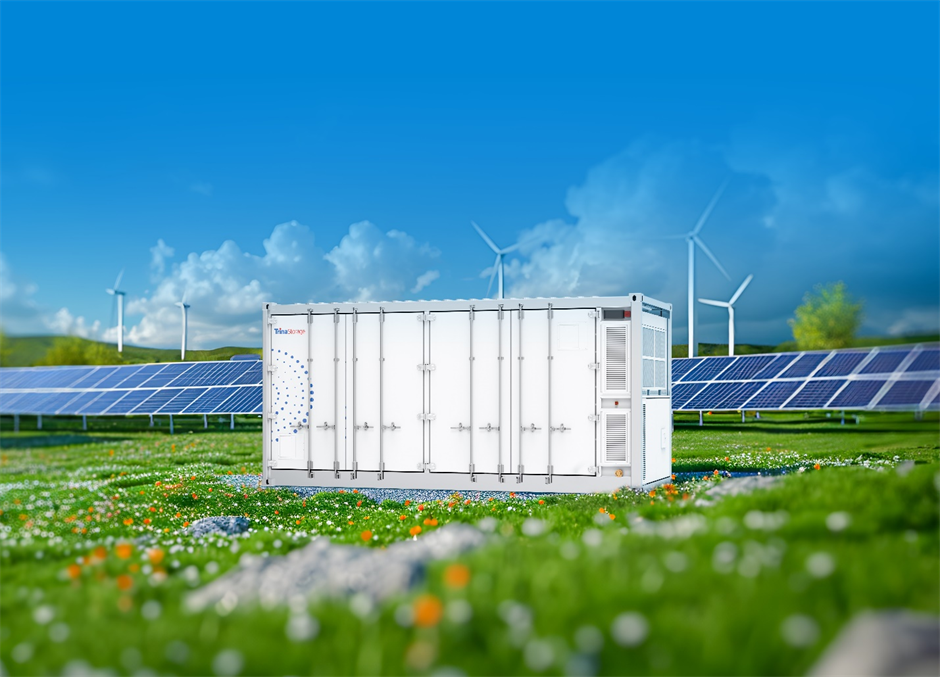
Trina Storage Elementa 2 Pro BESS container exemplifies Trinasolar's transition from a solar module provider to a smart energy solution provider.
Innovation as a Core Industry Driver
At Trinasolar, continuous innovation remains central to industry leadership and progress:
- Our development of perovskite tandem cells, which surpass current technologies in energy conversion efficiency, exemplifies our commitment to technological advancement.
- The integration of i-TOPCon technology into our latest solar modules further emphasizes our dedication to driving industry progress—enhancing module efficiency while optimizing overall cost-effectiveness.
- Our development of specialized products such as the Shield module, engineered to withstand severe environmental conditions like high winds, snow, and storms, ensuring reliable performance in diverse and challenging climates.
Our commitment extends beyond internal research and development efforts. We actively collaborate with leading academic institutions such as Nanyang Technological University (NTU) and A*STAR in Singapore to pilot advanced materials testing, AI-driven forecasting models, and integrated energy management systems (EMS). These strategic partnerships serve a vital role in translating cutting-edge laboratory research into practical, real-world solutions, ensuring continuous technological evolution and market readiness.
For Thailand, Trinasolar offers a suite of advanced, globally recognized solar energy technologies and innovations to support the nation's energy transition. The Vertex N i-TOPCon Ultra module exemplifies this commitment, employing state-of-the-art technology to maximize power output while maintaining cost efficiency. Such solutions position Trinasolar as a trusted provider of intelligent, scalable energy systems within Thailand.
Furthermore, our Elementa 2 Pro energy storage system and comprehensive residential energy solutions are instrumental in facilitating Thailand's shift toward clean energy across sectors—from power generation and industry to commercial enterprises and residential use. These products are meticulously designed to align with Thailand's climatic conditions, ensuring long-term stability, reliability, and sustainability of renewable energy resources.
How Trinasolar Supports Southeast Asia's Net-Zero Transition
Transforming the regional energy ecosystem necessitates coordinated efforts among policymakers, project developers, investors, OEMs, and research institutions. At Trinasolar, our guiding mission—“Solar Energy for All”—drives us to develop innovative technologies, foster strategic partnerships, and support scalable deployment efforts both globally and locally. Together, through these concerted efforts, we aim to build an equitable, resilient, and sustainable energy landscape across the Asia-Pacific region, capitalizing on innovation, system integration, and our unwavering commitment to a cleaner future.
Ready To Join the Clean Energy Transformation?
Get in touch with our experts to explore tailored solutions for your energy goals.

Relevant Topics
Smart Energy Solutions
delivered straight to your inbox