
Braving the Blue Frontier: Why Is Offshore PV the Asia Pacific’s Next Big Bet?
- 25/06/11
- 210 Modules Comprehensive Analysis,Business of Solar
Asia Pacific is home to sprawling coastlines, fast-growing cities, and energy-hungry economies. As solar installations sprawl across available land, developers, EPCs, and policymakers are now casting their eyes offshore.
Once considered a niche experiment, offshore solar energy has emerged as a serious contender in the region's race towards net-zero, especially in coastal and island nations where land is limited but marine potential is vast. According to Trinasolar's estimates, the Asia-Pacific region could install more than 50 GW of offshore PV, with Southeast Asia playing the biggest role because of its land scarcity, growing energy demands, and abundance of viable offshore areas.
Why Offshore PV?
The allure of offshore solar goes beyond just availability of space. It's a recipe for efficient, multi-use clean energy hubs.
Open water means less shading, more reflected light, and longer solar exposure, all translating to improved power output. The cooling effect of water naturally boosts solar module efficiency, ensuring optimal performance. Combined with lower site acquisition costs and reduced operational and maintenance costs from advanced performance monitoring, the total cost of ownership also gets a welcome dip.
Engineering for Extremes: Why Do Marine Environments Demand More From Solar Modules?
Offshore PV has to survive some of the toughest environmental challenges on Earth. Offshore environments are harsh: High humidity, salt spray, strong winds, pounding waves, and even seabird interference create a perfect storm of stressors for solar installations.
Here, reliable solar modules are a must, and leading solar module manufacturers are stepping up with robust solutions designed for offshore resilience. For instance, Trinasolar, one of the most trusted solar module manufacturers in APAC and globally, ensures offshore reliability through:
- Anti-corrosion treatments on bolts and mounting structures that prevent electrochemical degradation in high-salt environments,
- Dual-glass, double-coated front panels to prevent corrosion from water vapor and salt spray,
- Rigorous testing to ensure strong performance in marine environments, and
- Offshore certifications from external parties like TÜV Rheinland.
These mitigation strategies are implemented based on the solar installations' proximity to the shore. They account for salt spray intensity, humidity levels, mechanical stress, and corrosion risks, recommending enhanced materials and design for harsher zones.
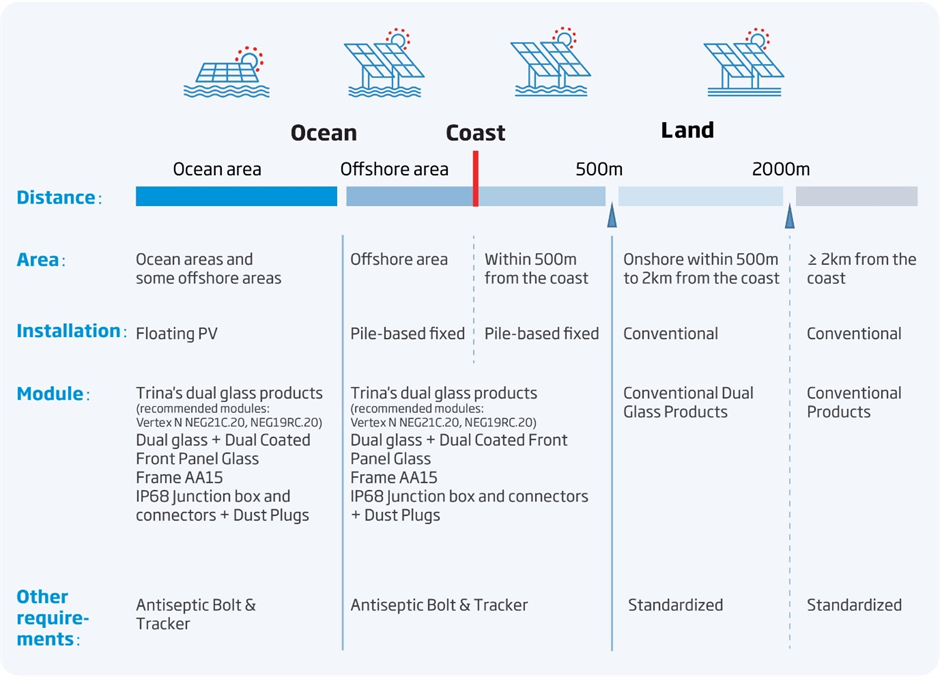
Offshore PV requires different installation methods and mitigation strategies to maximize reliability and performance in harsh marine environments.
Two Paths, One Future: Types of Offshore PV Solar Module Installations
Offshore solar can be installed either on piles in shallow waters or as floating solar in deeper seas.
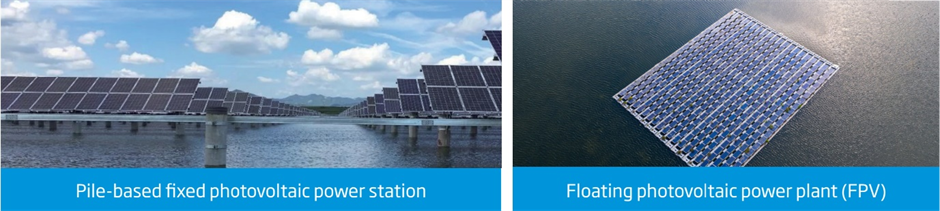
Offshore solar can be installed on piles in shallow water, or as floating solar in deeper waters.
Pile-based Fixed PV: A Tried-and-Tested Approach to Offshore PV
Shallow, stable waters (think aquaculture ponds or drained salt flats with less than eight meters of water depth) are perfect for pile-based fixed PV systems. These structures, elevated just above the waterline, form the backbone of fishery-PV models, where solar power generation and aquaculture coexist in symbiotic harmony.
This model is already the mainstream for offshore PV construction, thanks to its straightforward construction and dual-use value. For sites with access to low-depth waters, it's the obvious choice.
Floating PV: The Rising Star of Offshore PV
For deeper waters exceeding 8 meters in depth, floating solar becomes the go-to choice. Supported by buoyant platforms and anchoring systems, floating PV (FPV) makes use of otherwise unutilized marine spaces that are not prone to typhoons.
Floating solar is expected to become the main form of offshore PV applications in the future, with more than 60 countries around the world actively developing floating solar. Beyond offshore PV, floating solar is already proving its versatility across different environments:
- Freshwater floating solar
By deploying floating solar on freshwater surfaces, countries with limited land or abundant inland water bodies can scale renewable energy with minimal land investment.
- Reservoirs, like the 60 MWp Sembcorp Tengeh Floating Solar Farm on Singapore's Tengeh Reservoir
- Lakes and lagoons, including the 50.6 MW Dam Tra O Floating Solar Plant on a lake in Vietnam's Binh Dinh province
2.Hybrid set-ups
Floating solar also opens the door to hybrid power plants that combine multiple technologies or site-types:
- Floating + Land-based solar: In Merchang, Malaysia, a 100 MWac hybrid solar farm combines floating and land-based arrays to maximize generation in flood-prone areas.
- Floating + Hydropower: Thailand's 24 MWac Ubonrat Dam project in Khon Kaen combines floating solar with existing hydropower, maximizing electricity generated throughout the day.
Floating solar's versatility across freshwater and hybrid deployments underscores the expanding potential of offshore PV, especially when paired with modules engineered for marine durability.
Looking Ahead: A Shared Horizon of Waves and Watts
The future of offshore PV is even more compelling. Offshore solar could be integrated with aquaculture, green hydrogen production, and even co-located wind farms to create synergistic energy ecosystems, squeezing every watt out of every square metre of sea.
For developers, EPCs, and installers, the message is clear: the ocean is an emerging opportunity. The technology is ready, the testing is complete, and the market is hungry for offshore solar farms.
Are you ready to go offshore? Download the Offshore PV White Paper to dive deeper into the technology, testing protocols, and performance metrics shaping the future of offshore solar.

Relevant Topics
Smart Energy Solutions
delivered straight to your inbox