Select region / language
CHINA
NA
LAC
Field tests demonstrate Trinasolar 210mm Vertex modules’ higher energy yield
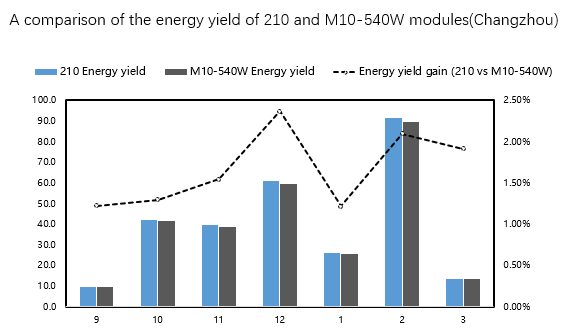 Field test in Yinchuan: This outdoor field test site is in the national Photovoltaic Quality Inspection Center in Yinchuan, where the accumulated duration of high irradiance (500W/m2 and above) is more than 2,000 hours a year. The project began in April, 2021 and is expected to be completed by April, 2022.
Test parameters:
Field test in Yinchuan: This outdoor field test site is in the national Photovoltaic Quality Inspection Center in Yinchuan, where the accumulated duration of high irradiance (500W/m2 and above) is more than 2,000 hours a year. The project began in April, 2021 and is expected to be completed by April, 2022.
Test parameters:
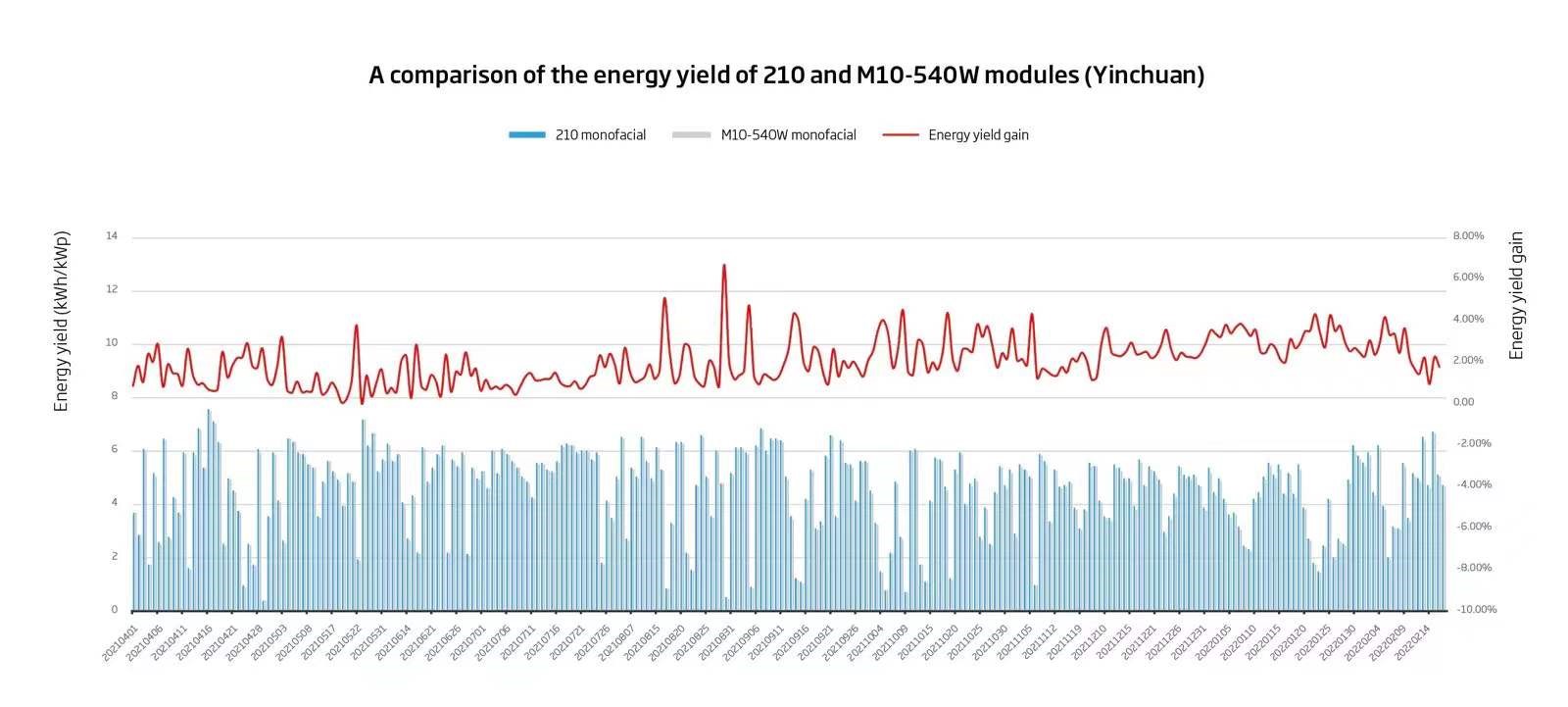 Three main advantages guarantee 210 Vertex modules’ higher power output:
1. Excellent low irradiation performance
210 Vertex modules have higher power output per watt when actual irradiation is lower than 1000W/m2.
Test results of the Yinchuan project show that on days of high irradiation the power output of the Vertex module is comparable to that of the M10 module, but on days of low irradiation the power output of the Vertex module is significantly higher. The following chart is based on three months’ comprehensive empirical data:
Three main advantages guarantee 210 Vertex modules’ higher power output:
1. Excellent low irradiation performance
210 Vertex modules have higher power output per watt when actual irradiation is lower than 1000W/m2.
Test results of the Yinchuan project show that on days of high irradiation the power output of the Vertex module is comparable to that of the M10 module, but on days of low irradiation the power output of the Vertex module is significantly higher. The following chart is based on three months’ comprehensive empirical data:
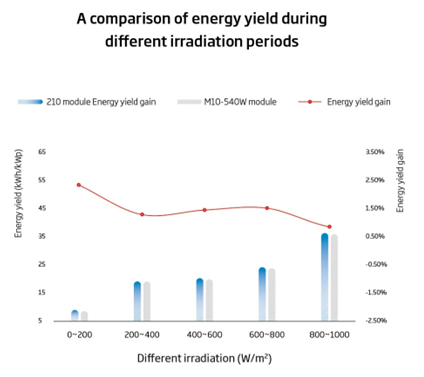 When the actual irradiation is lower than 1000W/m2 (STC standard testing condition), the loss due to inner resistance would have weaker impact on energy yield of Vertex 210 modules compared with that of M10 540W modules. So the low irradiation performance is significantly superior to that of the M10 540W modules. Taking data of June, 2021 as an example, the duration when irradiation exceeded 1000W/m2 accounts for only 3.98% of the whole testing span in Yinchuan, so the actual energy yield is determined by modules’ low irradiation performance. Vertex 210 modules are superior in overall energy yield performance.
2. Lower shading impact on both front and back side
In the practical application of PV modules, shadowing between arrays in morning and evening may cause a series mismatch between PV modules, reduce power generation efficiency and in severe cases produce hot spots, resulting in damage to the modules.
When the actual irradiation is lower than 1000W/m2 (STC standard testing condition), the loss due to inner resistance would have weaker impact on energy yield of Vertex 210 modules compared with that of M10 540W modules. So the low irradiation performance is significantly superior to that of the M10 540W modules. Taking data of June, 2021 as an example, the duration when irradiation exceeded 1000W/m2 accounts for only 3.98% of the whole testing span in Yinchuan, so the actual energy yield is determined by modules’ low irradiation performance. Vertex 210 modules are superior in overall energy yield performance.
2. Lower shading impact on both front and back side
In the practical application of PV modules, shadowing between arrays in morning and evening may cause a series mismatch between PV modules, reduce power generation efficiency and in severe cases produce hot spots, resulting in damage to the modules.
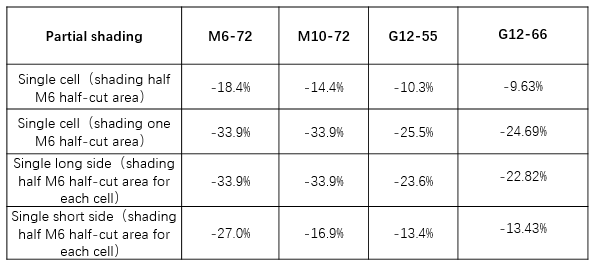
With the 210mm size silicon wafer and innovative layout design, the Vertex series modules can reduce power loss caused by shading in the same area compared with that of M10 540W modules, thus increasing power generation.
The following table shows the percentage of power degradation for different modules in various shading conditions:
Compared with M10 mono-facial modules, bifacial modules can draw on the advantage of air scattering and reflected radiation from the ground surface, so bifacial modules have higher power output.
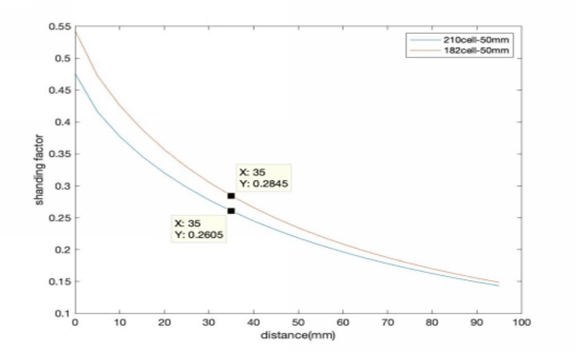
Radiation loss comparison simulation of 50mm purlin cells
In the application of bifacial modules, there will be beam crossing on the back side of the modules for some projects. Taking the 50mm purlin as an example, when the distance of purlins is at 35mm to cells, the equivalent shading loss of back side irradiation for 210 half-cut cells is 26.1%, and for 540W modules 28.5%.
To incorporate the irradiation of both front and back sides and the shading loss of back side irradiation into photo-coupling model, when the shading on the back side of bifacial modules is caused by the purlins of similar width, the energy yield of Vertex 210 modules is 0.09%~0.42% higher than M10-540W modules.
| 210-50mm purlin shading | M10-540W-50mm purlin shading | |
| Energy yield loss of grassland Albedo=0.2 | 0.52% | 0.61% |
| Energy yield loss of sandy ground Albedo=0.4 | 0.98% | 1.21% |
| Energy yield loss of white paint Albedo=0.7 | 2.27% | 2.69% |
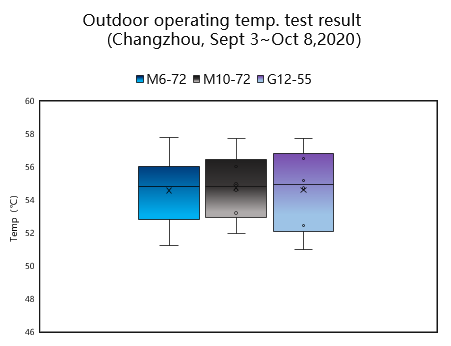 Test result of operating temperature of three types of modules
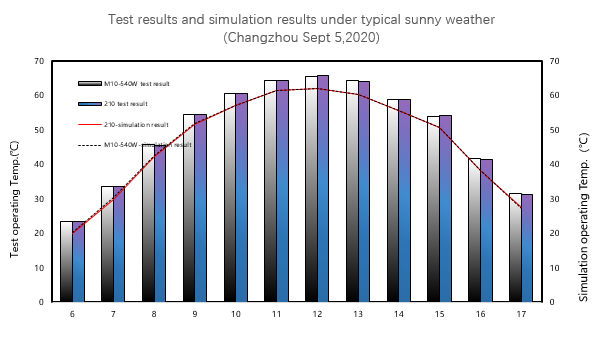
The date of September 5 was selected because the day was typically sunny and the measured meteorological data were substituted into the steady-state heat balance model. The measured and simulated results are compared with the following figure. Operating temperature of the 210 Vertex module and the M10 540W module are basically the same.
Test result of operating temperature of three types of modules
The date of September 5 was selected because the day was typically sunny and the measured meteorological data were substituted into the steady-state heat balance model. The measured and simulated results are compared with the following figure. Operating temperature of the 210 Vertex module and the M10 540W module are basically the same.



Customer Service Hotline