Inside the Wakefield Energy Park: What a Working Municipal Microgrid Tells Us About the Benefits of Energy Storage
July 29, 2026
 The American Public Power Association (APPA) National Conference took place in Boston, Massachusetts, from June 26 to July 1, 2026. It featured over 40 educational sessions focusing on grid modernization, energy transition policies, utility-scale storage, and microgrid energy storage integration.
It’s one thing to hear about an energy project at a conference — quite another to see it up close. So, during the APPA Annual Conference, select event attendees got a sneak peek at the newly commissioned Wakefield Energy Park, which is setting a new standard at the grid edge.
Hosted by the Wakefield Municipal Gas & Light Department (WMGLD), the Wakefield Energy Park Tour provided utility leaders from across the country with an on-the-ground look at what modern distributed energy infrastructure actually looks like when it's optimized and running smoothly in a real operating environment.
The American Public Power Association (APPA) National Conference took place in Boston, Massachusetts, from June 26 to July 1, 2026. It featured over 40 educational sessions focusing on grid modernization, energy transition policies, utility-scale storage, and microgrid energy storage integration.
It’s one thing to hear about an energy project at a conference — quite another to see it up close. So, during the APPA Annual Conference, select event attendees got a sneak peek at the newly commissioned Wakefield Energy Park, which is setting a new standard at the grid edge.
Hosted by the Wakefield Municipal Gas & Light Department (WMGLD), the Wakefield Energy Park Tour provided utility leaders from across the country with an on-the-ground look at what modern distributed energy infrastructure actually looks like when it's optimized and running smoothly in a real operating environment.
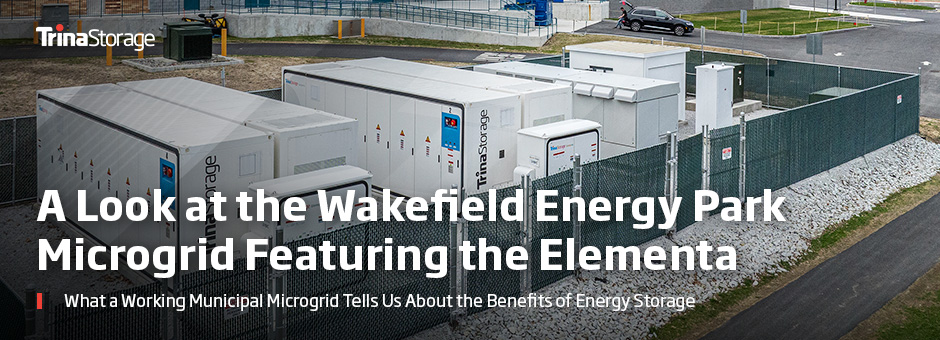
Importantly, the Wakefield Energy Park demonstrates how battery energy storage can serve as critical infrastructure, as showcased in the facility’s integrated microgrid, comprised of:
- 6 MW / 22 MWh Trina Storage Elementa Battery Energy Storage System (BESS)
- 2.6 MW natural gas generation
- Nearly 900 kW of community solar, adding renewable generation to the mix
- Peak shaving and emergency-backup capabilities
The energy park’s centerpiece, Trina Storage Elementa systems, are known for being highly reliable, bankable, safe, and flexible. It’s a genuinely integrated system, not a collection of separate assets. The Wakefield Energy Park installation is one of five successful operational collaborations between Trina Storage and Lightshift Energy, a leading developer, owner, and operator of distributed energy systems. In December 2025, the companies announced a partnership to deliver a portfolio of more than 1 GWh of energy storage projects across the United States.
What the Wakefield Energy Park Tour Conversations Revealed
The tour group consisted of:
- Wakefield Municipal Gas & Light Department leadership and Board members
- Lightshift Energy executive and project delivery teams
- Milton CAT representatives
- Massachusetts Municipal Wholesale Electric Company (MMWEC) leadership
- Municipal utility executives and engineers from across North America attending APPA
Tour discussions surfaced several key themes, chief among them this emerging truth: Battery energy storage is becoming non-negotiable infrastructure, not an optional upgrade.
“The discussions centered around how battery energy storage is supporting grid resiliency, peak demand management, renewable integration and future electrification initiatives,” said Doug Alderton, Trina Storage Head of Sales and Marketing. “It was especially rewarding to see this project operating successfully and to hear directly from the project partners about the collaboration required to bring it from concept through execution.”
Other themes that resonated with attendees included:
- Reliability as the primary driver: Even more than cost savings, the fundamental obligation of a municipal utility to keep the lights on. Storage helps fulfill that obligation in a grid environment defined by uncertainty.
- Design complexities: There’s a difference between peak shaving and a grid that can genuinely island — a gap many smaller municipal utilities are still working to close.
- Renewable integration pressure: Broader state renewable mandates are pushing more intermittent generation onto local grids, making storage more critical than ever.
What Grid Resilience Actually Means
During periods of high electricity demand, the grid is under stress, and utilities pay a premium for every additional MW they pull from the broader system. Battery storage helps shave those peaks by discharging stored energy during high-demand windows, reducing the load the utility places on the grid, and protecting against price spikes and potential supply shortfalls in the process.
When demand spikes or drops unexpectedly, the Elementa storage system can respond in milliseconds, absorbing excess power or injecting stored energy to keep things stable. But renewable generation doesn't always line up with demand. When solar generation exceeds what the local system can absorb, excess energy is wasted.
The Elementa captures that surplus energy and deploys it when it's needed, improving the utilization of renewable assets and reducing the effective cost of clean generation. In essence: The more storage capacity a grid has, the more easily it can absorb and redeploy renewable generation, reducing waste and improving the system’s overall payoff.
Wakefield’s Differentiator: Microgrid Energy Storage Islanding
Wakefield's Energy Park does something most municipal energy systems don't, and that’s what drew the most touring interest. A microgrid energy storage system that can "island" — that is, disconnect from the broader grid and operate independently — is a fundamentally different asset from a system that can only function when it’s connected.
The Wakefield system can operate in grid-connected, islanded, and “bridge-to-grid” modes, maintaining power delivery to the community even when the broader grid goes down. It sounds great conceptually, but designing a system like this is complicated, requiring careful coordination of stakeholders and components, as well as the right technology
Thanks to the Elementa’s grid-forming capabilities, the Wakefield Energy Park can operate reliably across modes, protect generators, stabilize frequency, and scale rapidly in constrained grid environments — all while unlocking economic value.
The energy park also reflects a broader industry movement toward grid resilience, propelled by a newfound urgency in energy demand. Municipal utilities like WMGLD are on the front lines of a shifting grid environment impacted by:
- Rising electricity demand from hyperscale AI data centers (AIDCs)
- An aging transmission infrastructure
- Extreme weather events increasing in frequency and severity
- Interconnection queues that extend for years
The Wakefield Energy Park serves as a prime example of a solution to these challenges. For one, according to Capgemini Research Institute, 86% of data center executives view the ability to island from the grid during power outages as a key competitive advantage. And seven in 10 data center leaders expect to significantly reduce their reliance on the grid through on-site power over the next five years.
For example, during the Summer of 2025, some 60 data centers in Northern Virginia's Data Center Alley simultaneously pulled 1,500 MW off the grid and switched to on-site generators. The event generated excess power, requiring both PJM and Dominion Energy to curtail generation to prevent outages.
Microgrids like the Wakefield Energy Park help prevent those near-miss events from becoming actual failures. For municipal utilities especially, the implication is clear: The grid they're connected to is changing fast, and they need to invest in flexible storage infrastructure now.
Trina Storage Elementa: The Right BESS for this Microgrid Project
What made the Elementa the right choice for a microgrid project this demanding?
The grid-forming BESS offers long lifespan and cycle performance, for starters, with Trina Storage cells delivering up to 12,000 cycles — critical for a municipal utility system or hyperscale AIDC that needs to perform reliably for decades. Bankability matters, too. Trina Storage is a financially strong and globally proven manufacturer, and that reputation instills confidence in municipal utilities that need a system that will be supported for its full operational life.
For municipal utilities, developers, and EPCs evaluating storage for new projects, Trina Storage recently introduced its Elementa 3 Platform to the North American market, bringing the advanced capabilities demonstrated at Wakefield to even more demanding applications.
Download the Elementa 3 Platform brochure, or explore more Trina Storage solutions.