Sun, Soil and Solar: How Agrivoltaics Solves Land-Use Issues and Creates Opportunities for C&I Solar EPCs
August 10, 2026
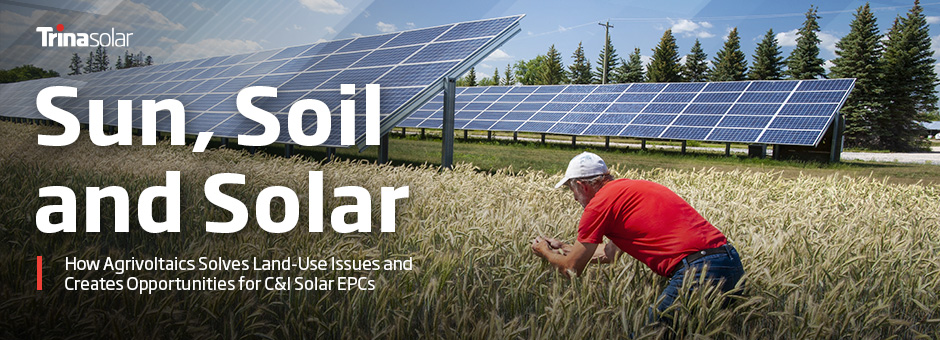
Sun, Soil and Solar: How Agrivoltaics Solves Land-Use Issues and Creates Opportunities for C&I Solar EPCs Landowners across the country have faced a version of the same question: Is this land better used for agricultural operations, for solar PV generation, or for agrivoltaics? 

Often, the question leads to pushback against solar development, with farmers, operators, and whole communities convinced solar installations mean sacrificing prime farming acreage. However, new data reveals a different picture.

The Solar Energy Industries Association (SEIA) recently launched an interactive Land Use and Solar Development map. With solar energy often coming under fire for supposedly using prime farmland, the new tool reveals that solar only accounts for only 0.04% of the country’s total land use and only 0.07% of U.S. farmland. SEIA also found that not only does solar not use more than 0.5% of prime farmland in any state, but nearly every state also has more abandoned prime farmland than solar-developed prime farmland. In fact, the organization discovered that golf courses take up almost three times more prime farmland than solar.

Despite the friction that sometimes arises between solar developments and farmland, agrivoltaics resolves the land-use question as an advantageous compromise for both sides. By co-locating solar PV systems and agricultural activity, farmers, ranchers, or operators can generate clean-energy revenue without sacrificing their land’s basic function. Solar and traditional land operations open new market opportunities for the C&I engineering, procurement, and construction (EPCs) who know how to capitalize on this growing sector.

Why Agrivoltaics Makes Sense Now

Several factors are converging and contributing to the growth of agrivoltaics, including:

  • Land pressure: Competition for agricultural land remains intense, forcing operators to extract maximum value from every acre. Farmers can earn extra revenue per acre annually from solar lease payments without sacrificing production, increasing the land’s total economic value.

  • Benefits for Crops and Livestock: Co-located solar installations can reduce irrigation demand and wind erosion, while protecting crops and livestock against adverse weather. Panels also create partial shade that moderates temperatures and reduces evapotranspiration — a benefit that’s particularly valuable for heat-sensitive and shade-tolerant crops. Shading from PV panels can also offer crucial comfort for livestock, reducing heat stress in grazing animals and improving production.

  • A fast-moving market: By late 2025, U.S. agrivoltaics capacity had exceeded 65,000 acres and more than 10 GW of capacity across nearly 600 operating sites. With the agricultural and financial benefits of agrivoltaics, the prospects for growth remain favorable. 

Leading states in the agrivoltaics movement include Colorado, Massachusetts, Maryland, New Jersey, and New York, with Colorado passing dedicated agrivoltaics grant legislation and a personal property tax exemption for solar equipment used in agrivoltaic operations. Solar developers who propose a project with an agrivoltaics component are also more likely to gain local government approval for new builds — a real, practical advantage in a permitting environment that can make or break project timelines. 

For corporate agricultural operators, food processors, and manufacturers with large land holdings, agrivoltaics represents a reasonable route toward meeting sustainability commitments while also generating economic returns.

Solving Some Dual-Use Solar Project Technical Challenges

Agrivoltaic projects are not a standard ground-mount deployment. The engineering demands can be more complex, and the right design separates a project that delivers on its dual-use promise from one that underperforms.

Core design requirements for effective agrivoltaic systems include:

  • Elevated racking. Panels must be mounted high enough to allow agricultural activity (machinery, animals, crops, etc.) to operate beneath them. This typically means post heights of 8–15 feet for crop and livestock applications, compared to the 2–4 feet common in standard ground-mount installations.

  • Wider spacing. Dual-use installations typically require larger gaps between rows so light still reaches the crops or ground under the panels. The right spacing depends on the specific crop, latitude, and the degree of shading desired. Keep in mind that the wrong spacing can lead to underperformance, even if energy production looked fine on paper during the design stage.

  • Compatible systems. Single-axis trackers significantly improve energy yield in agrivoltaic settings, but need to be designed for the structural realities of elevated, widely spaced installations and be capable of withstanding the weather conditions common to agricultural environments.

The good news for EPCs entering this space is that these technical challenges are, at this point, pretty well understood and increasingly well-supported. Elevated single-axis tracker systems have matured. The key is selecting module and system partners with both the product performance and the support infrastructure to execute on installation.

Trinasolar’s family of Vertex N modules is widely compatible with all major balance-of-system (BOS) components. Built on Trina’s advanced 210mm n-type TOPCon cell platform, the high-efficiency Vertex N enables more flexibility in site design and reduces CAPEX to lower LCOE.

Real World Agrivoltaics Applications and New Revenue Opportunities

Agrivoltaics projects across the U.S. and globally have demonstrated its viability across a diverse range of land uses and agricultural contexts, including for:

  • Crops: Highly reliable PV panels like the Vertex N Shield can protect crops from adverse extreme weather events, including hail and strong winds. Shade-tolerant crops like leafy greens, herbs, berries, and root vegetables are particularly well-suited to the microclimate created by elevated arrays.

  • Livestock: Animal grazing beneath solar arrays is one of the most immediately practical agrivoltaic applications. There are many co-benefits for both the solar project and the ranching operation. Sheep and cattle grazing beneath panels help manage vegetation, while panels provide shelter and reduce heat stress, sometimes even serving as fencing.

  • Aquavoltaics: Applying agrivoltaic principles to aquaculture, also called aquavoltaics, is an emerging but rapidly growing segment. Floating or shore-mounted PV systems above fish ponds and aquaculture facilities reduce evaporation, moderate water temperatures, and generate clean energy while preserving the water for use.

  • Manufacturing and Food Processing Operators: Maybe the most underexplored segment for C&I solar EPCs, large-scale food processors, agricultural product manufacturers, and other industrial operators often control substantial land holdings adjacent to their facilities. That land often serves little purpose beyond buffer zones or undeveloped acreage. 

Landowners can create steady income here: a dual-revenue model that can materially improve the economics of otherwise underutilized land. The C&I solar market is competitive, and developers and EPCs that can identify underserved segments with the right PV modules and strong fundamentals can successfully tap into the growing agrivoltaics market.

The Agrivoltaic Clients Already Exist, They Just Need the Right C&I Solar Partners 

Agricultural businesses, food processors, and land-heavy industrial operators with exactly the kind of acreage and operational profiles that make agrivoltaics work are plentiful. The policy environment is becoming more supportive, while the technology is proven and the economics genuinely compelling for the landowner.

With proper site development and decommissioning planning, agrivoltaics leave open the potential for a site to return to purely agricultural use in the future — flexibility that matters to many landowners hesitant to commit to a solar project that feels permanent.

The physical demands of elevated, large-format installations in agricultural environments — combined with the performance expectations of a long-term energy asset — make module selection a hugely consequential decision in agrivoltaics. Trinasolar’s Vertex N is built for the exact sorts of conditions necessary for a successful dual-use solar PV installation. 

Interested in learning more about how Trina’s Vertex N can work for your next dual-use C&I solar PV project? Reach out to our local team today.