Trina Storage announced enhancements to its global delivery framework through an upgraded AC System Validation Platform, strengthening the company’s ability to deliver reliable, grid-ready utility-scale battery energy storage systems (BESS) worldwide. The platform supports the company’s rapid expansion across more than 100 countries and its continued high-growth trajectory in the global BESS market.
Built on four specialized R&D laboratories, the platform integrates a self-built 35 kV medium-voltage test station, a 478 m³ environmental chamber, a system integration test facility, and a 1:1 hardware-in-the-loop energy management system (EMS) validation facility. Together, these capabilities enable Trina Storage to simulate real operating environments, verify system performance, and reduce commissioning risks before equipment reaches the project site.
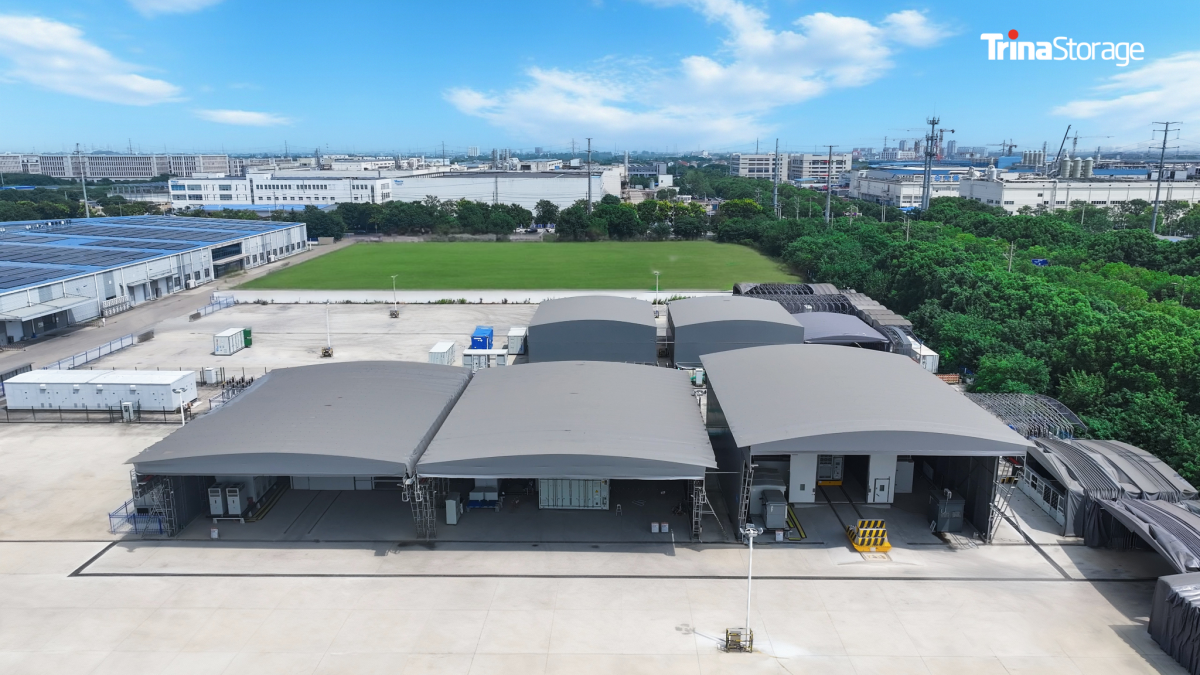
35 kV Station: Full-Chain Validation for Grid Readiness
Trina Storage is among the first in the industry to construct its own 35 kV MW-scale test station, removing the dependency on external grid resources and enabling more efficient, flexible, and repeatable testing. The station enables block-level pre-commissioning and high-voltage grid-integration testing under a true medium-voltage environment. With 24/7 testing availability and full-link validation capabilities, it significantly shortens project acceptance timelines and enhances delivery predictability.
Ultra-large Drive-in Environmental Chamber: Stability Across Global Climates
The 478 m³ chamber accommodates full 40-ft subsystems — including DC cabinet and MV-Skid, and tests them under extreme conditions from –50°C to +90°C and up to 98% humidity. Trina Storage’s dynamic full-load uniformity — maintaining temperature deviation within ±4°C — ensures system reliability across diverse environments, from cold northern regions to high-heat markets.
EMS Validation Laboratory: Ensuring Smarter System Behavior
The EMS validation platform specializes in system integration, functional validation, and performance optimization. Utilizing a Hardware-in-the-Loop (HIL) simulation platform, it can create a 1:1 model of an energy storage plant. This enables rapid validation of the EMS's capability to orchestrate the entire plant, ensuring precise and efficient operational management and enhancing overall system stability. This reduces on-site commissioning time and improves long-term operational stability.
Global Integration & Testing Capabilities in the U.S. and Europe
To meet regional requirements, Trina Storage has also established system integration testing capabilities across Europe and North America, forming a globally coordinated integration framework that enhances project delivery.
In North America, its State-Side Integration Testing (SSIT) validates AC systems prior to shipment, with each configuration receiving an SSIT Certificate confirming integrated components and test results.
In Europe, full-system integration testing for the Elementa 2 platform has been completed, confirming AC/DC compatibility, communication reliability, startup and shutdown behavior, operational performance, and fault-management response under local standards. These capabilities help ensure that each delivered system meets regional grid and compliance expectations.
“Ensuring that every system we deliver meets the highest standards of performance, safety, and reliability is central to our mission,” said Mr. Yang Bao, President of Energy Storage Division at Trinasolar. “By embedding advanced testing and integration capabilities across our global operations, we give customers the confidence to deploy energy storage at scale, supporting renewable adoption and reinforcing grid stability around the world.”
As Trina Storage continues to expand its innovation and production capabilities, it will keep investing in global validation infrastructure to accelerate the energy transition and ensure that every kilowatt-hour delivered is clean, safe, and dependable.