Trinasolar: Advancing UN Sustainable Development Goals through Innovation in Photovoltaic, Energy Storage and Smart Energy

November 12, 2026
Amid the accelerating global energy transition and the critical implementation period of the UN 2030 Agenda for Sustainable Development, Trinasolar, a leading global provider of smart photovoltaic (PV) and energy storage solutions, is systematically aligning its core business with the 17 UN Sustainable Development Goals (SDGs) through its deep technological accumulation and forward-looking strategic layout. Through the innovative deployment of “PV + Storage + Smart Energy Solutions,” Trinasolar has delivered a practical response across multiple dimensions, including poverty eradication, affordable and clean energy, industrial innovation, climate action, and biodiversity protection.

Technology as the Foundation: Driving Energy Accessibility and Industrial Upgrading through Full-Stack PV and Storage Innovation

UN SDG 7 explicitly calls for “ensuring access to affordable, reliable, sustainable and modern energy for all,” while Goal 9 calls for “building resilient infrastructure, promoting inclusive and sustainable industrialization and fostering innovation.” Trinasolar’s technological innovation practices are closely centered on these two core goals.

In PV technology, Trinasolar continues to lead industry innovation. Based on the TOPCon Ultra platform, the large-format TOPCon 3.0 Vertex 3 module reaches a maximum power output of 760 W. With ultra-high bifaciality and improved low-irradiance performance, it provides a more competitive power-generation solution for large-scale utility projects. THBC hybrid passivated back contact technology integrates the core advantages of TOPCon, HJT, and BC technologies, achieving simultaneous improvements in efficiency and power. Regarding next-generation technology, Trinasolar has set a world record with a perovskite/crystalline silicon tandem module exceeding 907 W, continuing to push the efficiency boundary of photovoltaic conversion. As of the first half of 2026, the company has cumulatively created or refreshed 41 world records for PV cell efficiency and module power, and leads the global perovskite patent rankings with 698 related patent applications.

In energy storage, Trina Storage has built full-stack capabilities from cells to the grid. Its 587 Ah high-capacity energy storage cells, Elementa 3 storage platform, and Electra 13.8 MW AC-side solution, combined with grid-forming control technology, enable autonomous voltage and frequency support and black-start and weak-grid adaptability, providing stable support for high-proportion renewable energy integration. As of the end of June 2026, Trina Storage has delivered more than 25 GWh globally in cumulative terms and has built complete verification capabilities from equipment to system levels through self-developed “Cell-to-Grid” full-stack core technologies.

Ecological Symbiosis: From a “Clean Energy Provider” to an “Earth Ecological Partner”

UN SDG 13 calls for “taking urgent action to combat climate change and its impacts,” while Goal 15 focuses on protecting “life on land.” Through scenario-based innovation under “PV & Storage + ecological governance,” Trinasolar transforms clean energy infrastructure into a tool for ecological restoration and biodiversity protection.

In the Shanghai Chongming Dongtan Birds National Nature Reserve, Trinasolar, together with NIO and the Nanjing Institute of Environmental Sciences of the Ministry of Ecology and Environment, built a PV-storage-charging microgrid green energy replenishment station project. As the first stop of the “UNDP–NIO Clean Parks National Park Ecological Co-building Project,” the project adopts an off-grid “self-generation for self-consumption” model to provide green electricity for patrol vehicles in the reserve. The PV panels adopt a low-tilt design to minimize the impact on migratory birds’ line of sight, safeguarding wetland ecology and migratory bird flyways while ensuring net-zero operation and maintenance. This practice has become a model of coordinated progress in clean energy and biodiversity protection.

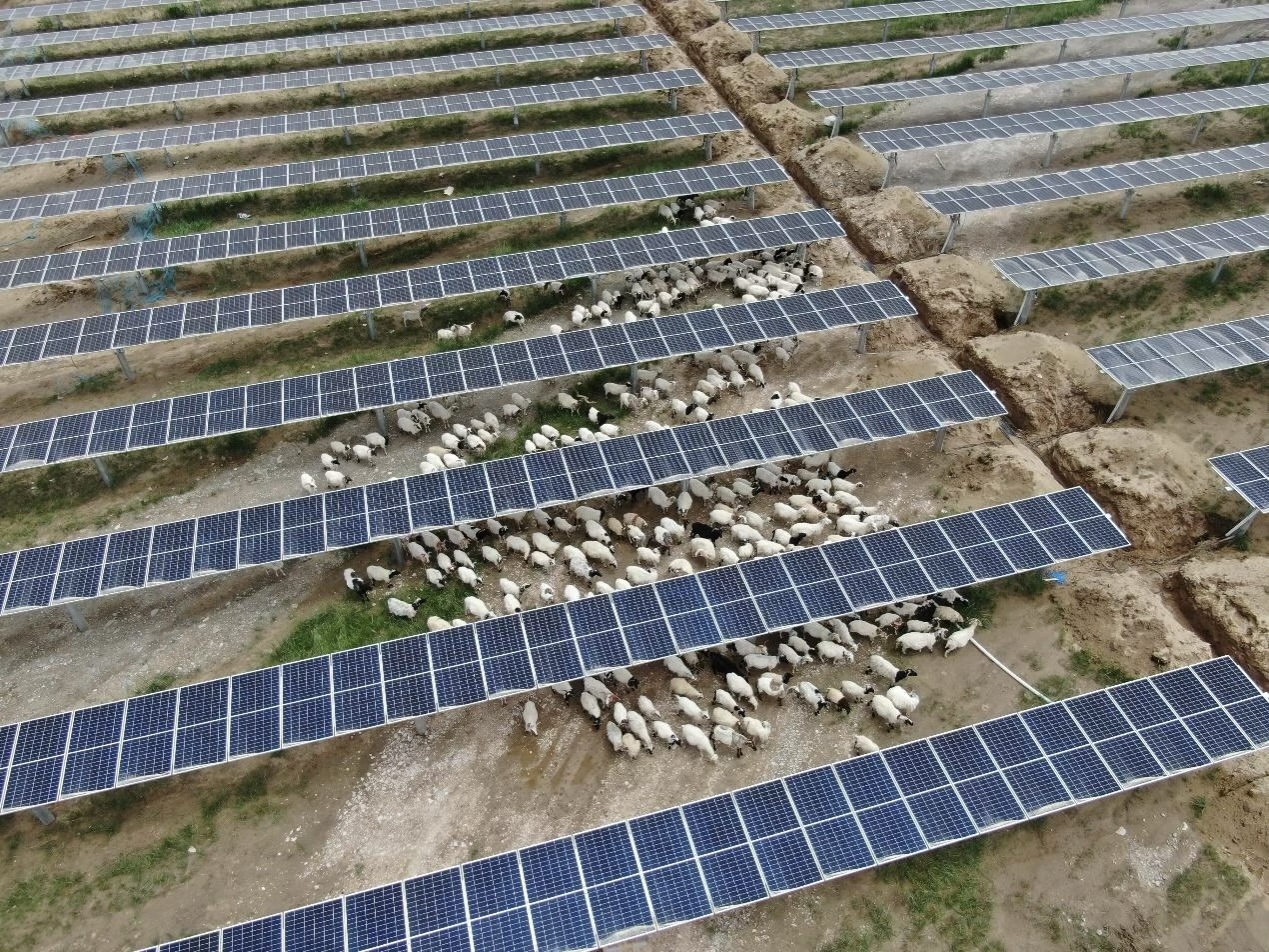
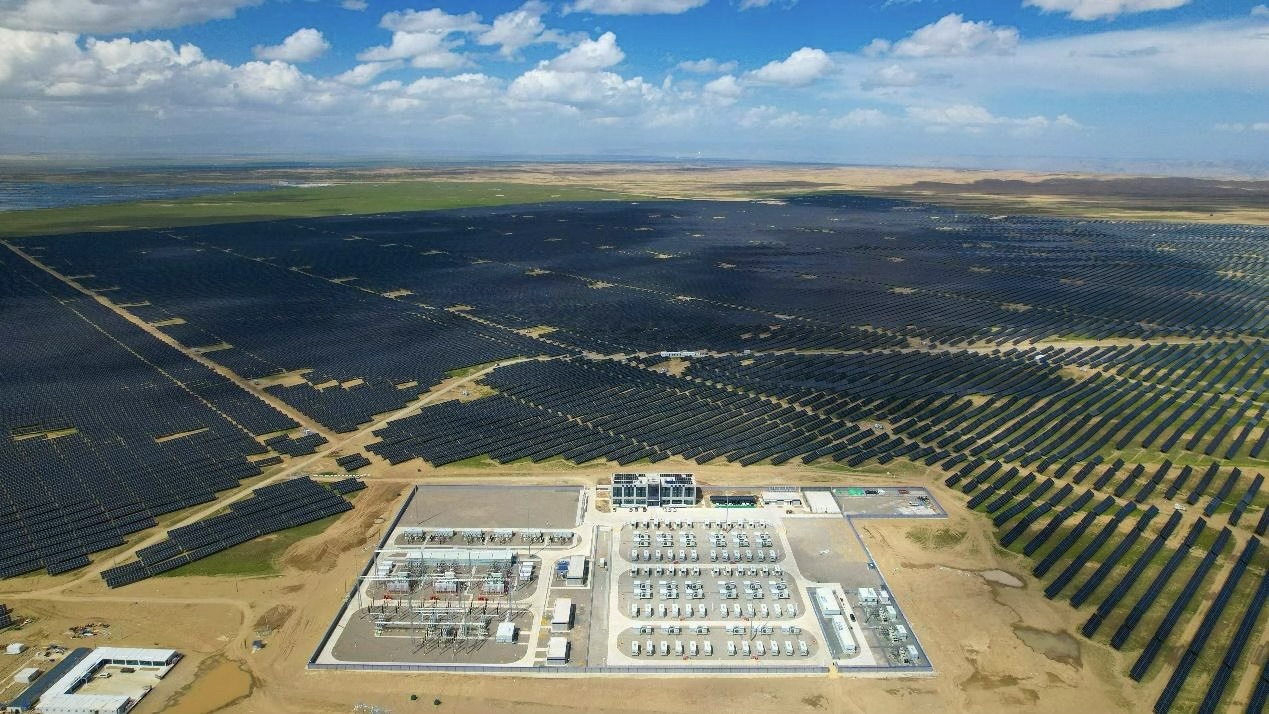
In the desert areas of northwest China, Trinasolar promotes degraded land restoration through a “PV & Storage + ecological governance” model. The Qinghai Talatan PV power station uses the shading effect of PV panels and the infiltration of cleaning water to enable lush pasture to grow on what was once barren land. Local herders have innovatively introduced “PV sheep,” creating a pastoral-PV complementary ecological picture of “power generation above the panels, grass planting below the panels, and breeding between the panels.” By the end of 2025, the PV ecological pasture in Hainan Prefecture alone had reached a breeding scale of 21,000 sheep, benefiting thousands of herder households. From the “wind-solar-storage-grid-computing” five-dimensional coordinated zero-carbon computing power demonstration project in Sanjiangyuan, Qinghai, to the grid-forming energy storage benchmark project in Atacama, Chile, Trinasolar is extending the value of “PV & Storage + ecological governance” from China to the world.

Responsibility as the Foundation: Sustainable Supply Chain and Inclusive Social Development

UN SDG 8 advocates “promoting sustained, inclusive and sustainable economic growth, full and productive employment and decent work for all,” while Goal 12 calls for “ensuring sustainable consumption and production patterns.” Trinasolar deeply embeds sustainable development into supply chain governance and product life-cycle management.

In building a sustainable supply chain, Trinasolar has innovatively established a “digital-intelligent traceability” system and self-developed the “Smart Carbon” product carbon digital management system, giving exported products a “green digital identity.” The company focuses on responsible mineral traceability and has established a full-chain traceability mechanism for conflict minerals. This mechanism ensures compliant sourcing and transparent processes. Requirements such as eliminating forced labor and prohibiting child labor are embedded into supplier admission and audit processes. Trinasolar has obtained TÜV Rheinland’s highest AA rating for full-chain traceability of the PV supply chain, covering every stage from polysilicon to modules. In the field of circular economy, Trinasolar has successfully developed the world’s first fully recyclable and regenerated PV module, won first prize in the PV Module Recycling Category of the Ministry of Industry and Information Technology’s Energy Electronics Industry Innovation Competition, and is promoting the implementation of its “Reduce, Reuse, Recycle” 3R strategy.

In terms of green manufacturing transformation, several Trinasolar manufacturing bases have been recognized as national-level “Green Factories.” The company has set a clear long-term goal: to achieve net-zero emissions by 2050.

On inclusive social development, Trinasolar, through the RMB 3 billion-scale inter-institutional REITs project under TrinaPower, is unlocking the value of more than 28,000 household distributed PV projects across 10 provinces nationwide, organically combining the green energy transition with farmers’ income growth. As a member of the UN Global Compact (UNGC) and a signatory of UN Women’s Women’s Empowerment Principles, the company continues to promote a diverse and inclusive workplace environment.

Global Collaboration: Accelerating a Net-zero Future through Partnerships

UN SDG 17 calls for “strengthening the means of implementation and revitalizing the global partnership for sustainable development.” Trinasolar has long upheld open innovation and works with global partners to advance the scaled deployment of clean energy.

In Europe, Trinasolar has entered into a strategic cooperation with Gore Street Capital to participate jointly in a dedicated private fund focused on battery energy storage systems (BESS) in the 27 EU countries, advancing the implementation of 12 GWh energy storage projects. In Latin America, TrinaTracker provided its Pioneer 1P intelligent tracking system for the PV section of the 345 MW wind-solar hybrid power station in La Rioja Province, Argentina, setting a technical benchmark for complex terrain and high-wind environments. In Asia-Pacific, the Middle East, Africa, and other regions, Trinasolar’s products and solutions have covered more than 180 countries and regions worldwide.

Trinasolar will always uphold its mission of “Solar Energy for All,” rely on its core capabilities in PV and energy storage, drive smart energy technology innovation, and embed the 17 UN Sustainable Development Goals into its corporate strategy and conscious actions in daily operations. From technological breakthroughs to ecological restoration, and from supply chain governance to global cooperation, Trinasolar is responding to the global sustainable development agenda with systemic innovation and contributing replicable and scalable industrial practices to building a net-zero future.