Select region / language
CHINA
NA
LAC
Trina Storage Wins 2026 AIDC Energy Storage TOP Benchmark Award as Japan Expands AI Data-Centre Infrastructure
Full-stack capabilities span battery cells, DC containers, grid-forming PCS, AI-enabled EMS, power distribution and cooling
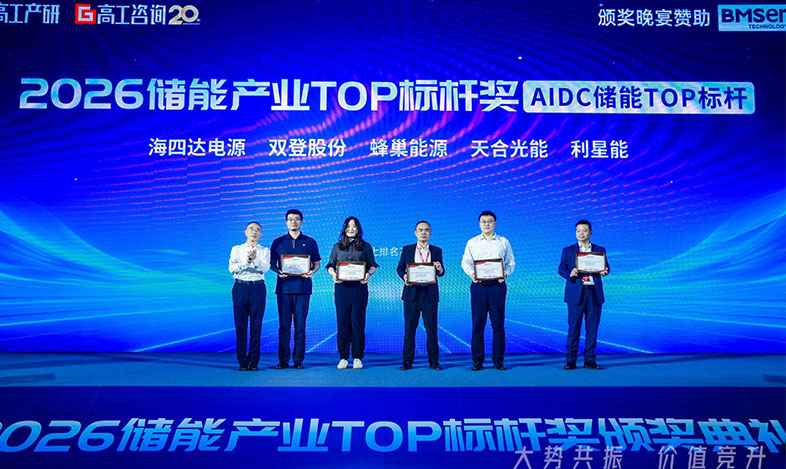
Trina Storage, the global energy storage solutions provider and a business unit of Trinasolar, has received the 2026 “AIDC Energy Storage TOP Benchmark Award” for its full-stack energy storage and power architecture for artificial intelligence data centres. The award was presented on 24 July at the 2026 Gaogong Energy Storage Summit in Nantong, Jiangsu, China.
Trina Storage’s AI data centre (AIDC) solution integrates proprietary technologies from battery cells and DC containers to power conversion systems (PCS), energy management systems (EMS), power distribution and cooling. It is designed to address the rapid load fluctuations, high power density, power-quality requirements and resilience needs created by AI computing.
Japan’s Agency for Natural Resources and Energy expects national electricity demand to rise from 803.4 TWh in fiscal 2025 to 846.1 TWh in fiscal 2035, with new data centres and semiconductor plants among the drivers. Japan is also promoting closer coordination between power and communications infrastructure through its “watt-bit collaboration” policy, while local operators plan higher-density, liquid-cooled and more geographically distributed AI facilities. These trends increase the need for AIDC power systems that can combine fast response, resilience, efficient cooling and intelligent coordination of generation, storage, grid and load.
On the source and storage side, Trina Storage’s AIDC solution is centred on grid-forming technology and integrates self-developed core technologies across battery cells, DC containers, PCS and EMS. This gives Trina Storage control over the components and system functions needed to respond to demanding AI computing loads.
The pulse-tolerant cells use anti-fatigue soft-matter mechanics and heterogeneous interface engineering to support short-duration, high-power pulse discharge without compromising cycle life. Performance-enhanced DC containers combine this cell technology with intelligent predictive thermal management, enabling rapid response to load fluctuations and high overload capability.
Trina Storage’s grid-forming PCS provides full-range weak-grid adaptability and station-wide black-start capability, while suppressing wide-band oscillations. The computing-electricity collaborative EMS uses large AI models to forecast loads at second-level resolution and coordinate hundreds of PCS units at millisecond level. It also manages real-time data from millions of cells, supporting system control and resilience across the storage fleet.
Trina Storage is applying its source-grid-load-storage approach in China. The Sanjiangyuan Green Power and Intelligent Computing Integration Demonstration Project provides year-round direct renewable power to computing loads. The grid-connected Golmud 135 MW/540 MWh energy storage project provides peak-shaving and frequency-regulation services to local computing centres, while the Qinghai Hainan Prefecture 1,000 MW integration project is designed to match nearby renewable generation with regional computing demand.
“AI data centres need an energy architecture capable of responding to fast-changing, high-density computing loads. Trina Storage’s strength is our ability to integrate the full chain, from pulse-tolerant cells and grid-forming PCS to intelligent EMS, power distribution and cooling. As Japan expands its AI infrastructure, we will work with local customers and partners to apply these capabilities around Japan’s grid conditions, safety standards and operating requirements,” Dr. Leo Zhao, Head of Energy Storage, Trinasolar Asia Pacific.
The award recognises Trina Storage’s ability to combine energy storage technology, power electronics, digital control and project delivery for AIDC applications. Trina Storage will continue to develop these capabilities with ecosystem partners and engage with customers in Japan on the requirements of high-density AI computing.



Customer Service Hotline
+65 6808 1111