Select region / language
CHINA
NA
LAC
Trina Storage and AMP-lify Sign MoU for 1 GWh of Grid-Connected Battery Storage Projects in Japan
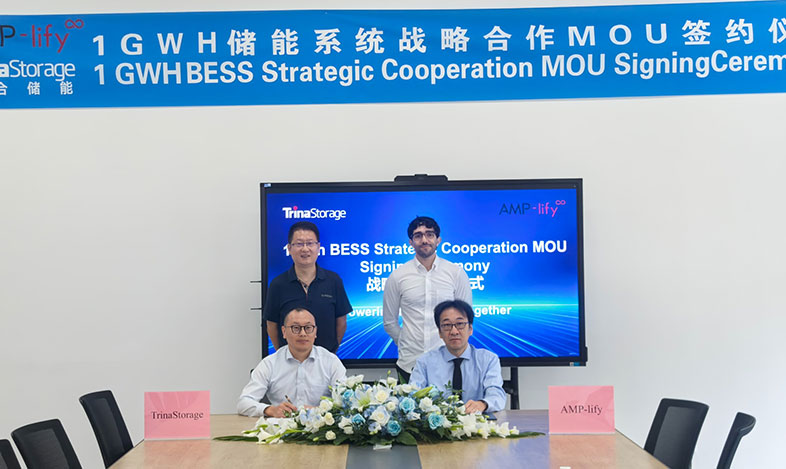
Trina Storage, the energy storage business unit of Trinasolar, has signed a Memorandum of Understanding (MoU) with AMP-lify, a Japanese clean energy platform, to supply approximately 1 GWh of grid-connected battery energy storage system (BESS) equipment for AMP-lify’s projects. AMP-lify develops, constructs and operates grid-connected BESS, utility-scale solar, and onshore wind projects across Japan.
Under the MoU, Trina Storage will supply its Elementa 3 series BESS and provide related technical support for approximately 1GWh of AMP-lify’s BESS projects. Trina Storage’s Japan team will support system configuration, technical consultation, delivery coordination and after-sales service.
Trina Storage’s Elementa 3 is equipped with Trina Storage in-house 587Ah high-capacity cell, providing up to 6.25 MWh per container for larger utility-scale sites. For projects affected by transport access, limited land or proximity to communities, the 1.56 MWh Elementa 3 Flex offers an approximately five-square-metre footprint, a weight of about 13 tonnes for standard-truck transport, operating noise of 65 dB or less and modular expansion.
Japan’s Seventh Strategic Energy Plan projects renewable energy at approximately 40–50% of power generation in fiscal year 2040 and calls for storage batteries to help balance renewable output. As variable renewable generation increases, developers need storage projects that combine appropriate system design with local execution and long-term support. Trina’s Storage’s BESS technology and Japan-based support arebacked by its recognition as a BloombergNEF Tier 1 energy storage supplier for 11 consecutive quarters.
“Japan’s storage market needs projects that are technically sound and executable under local conditions. Working with Trina Storage’s technology and local support gives us a strong basis to move the projects from site evaluation through construction and into reliable operation,” said Martin Stein, Representative Director and CEO of AMP-lify.
“Japan’s storage market has distinct engineering and delivery requirements. Road weight limits and narrow site access affect transport, while mountainous terrain, limited land, community noise expectations, seismic design and coastal conditions influence system configuration. This MoU allows us to address those factors with AMP-lify from the earliest stages of development. By combining its local execution capabilities with our Elementa 3 portfolio and Japan-based technical support, we can configure each project around its site requirements while building toward the scale envisaged under this cooperation,” said Dr Leo Zhao, Head of Energy Storage, Trinasolar Asia Pacific.



Customer Service Hotline
+65 6808 1111