How To Mitigate Growing Solar Project Risks of Hail, Fire, Wind, and Snow in C&I Solar Projects
June 25, 2026
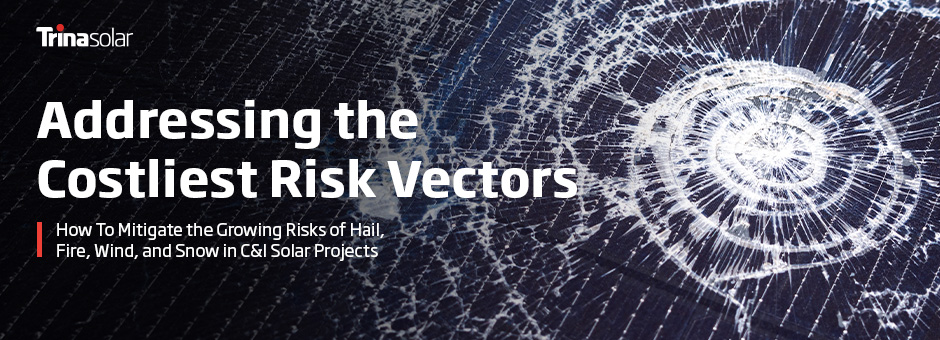
The commercial and industrial (C&I) solar sector is navigating one of its most demanding environments on record, as risks become more localized, technical, and costly. Two consecutive editions of the kWh Analytics Solar Risk Assessment — the industry's most rigorously sourced annual analysis of solar project risks — have painted a consistent and sobering picture. Hail is catastrophically expensive, fire risk is accelerating, module degradation erodes project returns year after year, and regulatory compliance is becoming more complex.
For C&I solar EPCs and project developers that must satisfy lenders, insurers, and off-takers for three decades, it’s clear that PV module selection is as much a risk-management decision as a procurement decision.
What’s the cost of getting that decision wrong?
Potentially millions in losses.
The financial stakes may run into millions in damage, insurance claims, and lost generation — not to mention the reputational risk EPCs face when systems fail prematurely.
The High Cost of Hail Damage Without Hail-Hardened PV Modules
Last year’s kWh Analytics Solar Risk Assessment reported that hail accounts for 73% of total insured solar lossesby damage amount, despite only representing 6% of loss incidents. A single severe hailstorm can destroy a project's financial model in minutes. Most PV modules are not engineered to withstand anything close to the largest hailstones that NOAA now routinely documents. Baseball-sized hail (approximately 70 mm in diameter) has been documented in major loss events across Texas, the Plains states, and the Mountain West. Meanwhile, the standard IEC 61215 hailstone test uses a 25mm projectile — less than half the size of what real-world severe weather releases.
The
2026 Solar Risk Assessment builds upon last year’s analysis, noting that hail remains the single most expensive insured peril. Last year, the average cost per hail damage claim reached approximately $58.4 million per incident, with some individual events resulting in several hundred million dollars in losses.
Projects in 52% of the country require some hail mitigation beyond standard 2mm/2mm glass modules, while 13% of the country presents the highest risk and requires hail-hardened modules that can be robustly stowed. The takeaway is that the module's physical and material attributes lie at the center of most major loss categories. Even lenders and insurance underwriters have noted that bankability in today's market increasingly hinges on demonstrated module reliability, not just on nameplate power and efficiency ratings.
Additionally, although hail’s threat is inherently localized, the Solar Risk Assessment Report noted that NOAA data might be underrepresenting the number of severe hail days (those storms with hailstones two inches or larger) — putting projects at greater risk than originally planned.
Trinasolar’s hail-hardened 620W Vertex N Shield directly addresses the industry's costliest risk vector. Engineered to withstand direct 55mm hail impact per IEC standards at 33.9 m/s, and up to 75mm hail at a 45-degree angle, Vertex N Shield performs above and beyond what most commercially available panels offer to mitigate C&I solar project risks. The module’s reinforced dual-glass design, with surface compression stress exceeding 69 MPa, delivers impact-energy resistance 2.5 times greater than that of conventional glass-backsheet modules.
The result? Effectively reducing the probability of hail-related losses by more than 50%. For EPCs designing projects in hail-exposed geographies, this level of protection can mean reduced insurance premiums, lower reserve requirements, and stronger bankability arguments with lenders who have become acutely aware of hail tail risk.
Address Growing PV System Fire Risks by Exceeding Industry Standards
The 2026 Solar Risk Assessment identified fire risks as an emerging concern, attracting increasing scrutiny from insurers, local jurisdictions, and grid operators. Notably, the assessment found that 84% of solar PV fire events are caused by identifiable equipment-related factors stemming from the materials and components used in system construction.
Vertex N Shield carries UL 61730 Fire Type 30 certification, delivering Class A performance across all UL fire tests and exceeding industry standards to help mitigate solar project risks. For C&I developers, Class A fire ratings have moved well beyond a technical checkbox and now determine whether a project can be permitted in increasingly fire-aware jurisdictions, a utility will interconnect under specific conditions, or an insurance underwriter will offer preferred-rate coverage.
Mechanical Load Ratings Engineered for the Harshest Environmental Solar Project Risks
Weather data consistently shows that wind, snow, and combined loading events are intensifying in frequency and severity, requiring structural engineers to revisit load assumptions that were standard practice five years ago. The Vertex N Shield, for instance, is rated for +7,000 / −5,000 Pa in fixed-tilt configurations — among the highest available for a commercial-format module, and nearly three times the IEC 61215 baseline of ±2,400 Pa.
For tracker-mounted installations, the Shield module maintains +3,600 / −3,000 Pa even at a compact 790mm purlin spacing, much closer than what traditional modules need to achieve comparable load ratings. This kind of high load performance at tighter spacing enables system designers to reduce racking steel costs without compromising structural integrity.
In high-latitude and mountainous markets where snow accumulation can cause structural failures in less resilient systems, the Shield module maintains exceptional performance with a +6,600 Pa uneven snow load rating, equivalent to about 7.2 feet of snow.
No Need to Sacrifice PV Performance for Durability when Mitigating C&I Solar Project Risks
There’s a fairly common misconception that using reinforced modules will compromise output. That’s not only inaccurate, but it’s also reductive in that it creates a false binary. In reality, there’s no need to decide between long-term module durability and PV system performance.
Built on Trina’s 210mm n-Type TOPCon advanced technology platform, the Shield module delivers the same electrical characteristics as Trina’s established medium-format Vertex N lineup, ensuring validated performance specifications that preserve compatibility with mainstream trackers and inverters while capturing the power-density advantages of Trina’s large-format cell technology.
The module’s high efficiency directly reduces the land area, racking units, wiring runs, and installation labor compared to traditional modules, resulting in lower balance-of-system (BOS) costs and levelized cost of electricity (LCOE). For C&I projects where rooftop area is constrained, or ground-mount land is expensive, efficiency translates into project feasibility that lower-efficiency alternatives cannot match. Additionally, Vertex N Shield’s low-voltage design reduces string-level losses and enables longer string lengths, thereby reducing combiner box counts and DC wiring complexity. Combined with its high bifaciality and strong low-irradiance performance, the module generates more energy per installed watt across the full range of real-world irradiance conditions.
Low degradation rates add to the protection: one percent in year one, 0.4% annually, and backed by a 30-year power warranty. As a result, buyers get both protection and confidence in long-term energy yield.
Interested in learning more about mitigating C&I solar project risks with the reliability and performance of Trinasolar’s Vertex N Shield? Contact the local team today.
Follow us on social media: Stay updated on the latest news, events, and insights from Trinasolar US by following us on LinkedIn, YouTube, Twitter, Facebook, and Instagram.We regularly share insights and educational information on product updates, industry trends, and strategies to help you succeed.