Fast, Durable, and Domestic: What C&I Module Procurement Teams Should Weigh Before Dec. 4
October 6, 2026
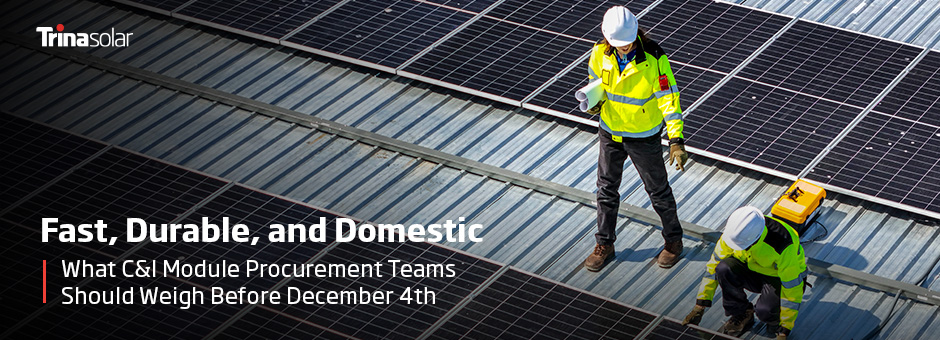
Two C&I solar EPCS on a building's roof inspecting a rooftop C&I solar PV system, with text that reads, "Fast, Durable, Domestic: What C&I Should Weigh Before Dec Deadline." With a new round of Section 232 trade measures set to take effect on December 4, 2026, commercial and industrial (C&I) solar engineering, procurement, and construction (EPCs) firms must move quickly to secure C&I module supply. As buyers race toward yet another rapidly approaching regulatory deadline, EPCs must stay diligent in procuring highly reliable and durable PV modules. Commercial solar customers aren't just buying lower energy costs anymore. Companies are now increasingly buying energy resilience, and a module that underperforms undercuts that goal regardless of how attractive the deal looked at signing. This concern is especially relevant considering the growing trend of failures among lower-tier PV modules that can’t withstand extreme weather conditions.   Procurement teams face a tension between moving fast enough to beat the deadline, but not so fast that they end up stockpiling C&I solar module supply that can’t survive a hailstorm a few years down the road.

The C&I Solar Module Supply Race

The next two months will test C&I procurement teams. EPCs will need to secure favorable sourcing terms before the deadline and navigate an evolving compliance landscape, while ensuring the modules they lock in will handle two decades on a commercial roof or in the field. Anza, a solar and energy storage data and analytics company, expects at least a 40% spike in imported module prices after the tariffs go into effect.   Broader market reports have shown that buyers who waited to secure module supply ahead of the July 4th construction start deadline earlier this year found themselves with far less negotiating power than in prior quarters, and in some high-demand categories ended up paying more than list price just to guarantee availability. That’s a preview worth taking seriously for any EPCs tempted to wait until the last minute. Check what's sitting in U.S. warehouses, since inventory that's already landed skips the customs-timing gamble entirely.

In this scramble to secure C&I solar module supply, it’s also worth remembering that now’s the time to take a good look at PV modules with domestic content. Beyond ticking a compliance box, domestic-content C&I solar module supply may be the smartest way to structure a resilient project.

PV Module Quality Cannot be an Afterthought

Of course speed matters, but it’s not enough. Facility managers and owners used to ask how quickly a system could come online and how much it’ll offset current energy usage. Now they also ask how well the C&I solar system will behave in a bad hailstorm, a heat wave, or a rough winter. Their operations can't stop for long, and many see on-site solar as part of keeping the lights on and the doors open, especially with ever-growing grid outages. Module durability must be part of the pitch, but when you promise resilience, the module is the first thing that must deliver it.

Hail is the clearest example, accounting for 73% of insured solar losses by damage amount, even though it makes up only 6% of loss incidents.

The standard IEC 61215 hail test uses a 25 mm projectile, while baseball-sized hail around 70 mm has been documented across Texas, the Plains states, and the Mountain West. It’s estimated that projects in 52% of the country need hail mitigation beyond standard 2mm/2mm glass, with 13% of the country smack dab in the highest-risk category.

Wind, uneven snow loads, and fire exposure also shape how a module ages. Damage doesn't always show on day one, and a microcrack from one storm season can become a serious performance issue two years later.

Yet, Kiwa PVEL’s 2026 PV Module Reliability Scorecard found a rise in failures in at least one Product Qualification Program (PQP) among 87% of manufacturers and 61% of the bills of materials (BOMs). The report did show gains elsewhere, though, in climbing energy yields and lower post-test power loss in Potential Induced Degradation (PID) and UV-Induced Degradation tests.

This apparent contradiction arises from how some manufacturers compete on efficiency and cost. Intense pricing pressure has led some module original equipment manufacturers (OEMs) to reduce materials by using thinner encapsulants and lighter frames to increase module efficiency. These trade-offs can lower costs and improve performance metrics, but they introduce serious quality issues.

Domestic Content Modules with Enhanced Protections Against the Elements

Trinasolar’s Vertex N Shield module has been through Kiwa PVEL environmental stress testing covering PID, LID, LeTID, salt mist, ammonia, and high-dust conditions. It has also been named Overall Highest Achiever in RETC's 2025 PV Module Index, backed by a 30-year performance warranty.

The fixed-tilt wind rating is nearly three times the IEC 61215 baseline of ±2,400 Pa. The Vertex N Shield module also has the same electrical characteristics as Trinasolar's innovative medium-format n-type TOPCon module, so choosing durability doesn't mean sacrificing high-performance output or widespread compatibility with mainstream trackers and inverters.

The Vertex N Shield, a U.S.-manufactured, third-party-validated module, will hit the 12.3% domestic content threshold in Q4 2026 and the 12.9% threshold in Q1 2027.

A Quick Checklist for Reliable C&I Module Supply Procurement

When speaking with suppliers in the coming weeks, these questions can help keep durability in the picture:

  • Which hail, wind, and snow load certifications apply, and under what mounting conditions?

  • What glass construction does the module use, and has it passed third-party reliability testing?

  • Does the fire rating suit the rooftop or carport applications on your pipeline?

  • What does the power warranty cover, and how long does it last?

  • Can the supplier support your delivery schedule without compromising on any of the above?

  • What’s the PV module’s domestic content percentage?

Customers will remember how their C&I solar system performed through its first major storm long after they'll remember the order date. Securing supply before December 4 is a sound priority, but choosing a module built for the sites you serve is what makes that supply worth having.

Interested in procuring high-performance, domestic-content C&I solar modules with enhanced protection against the elements? Reach out to Trina’s local team today.