Select region / language
CHINA
NA
LAC
Trinasolar Powers Australia’s First Nike Swoosh Shaped PV Installation
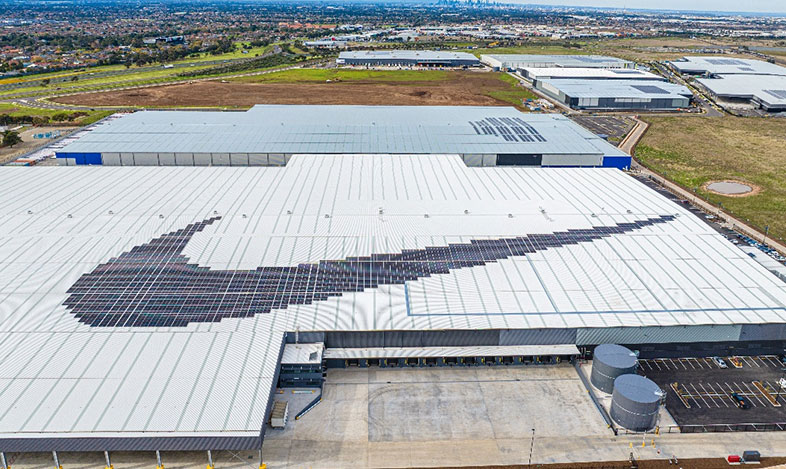
Sydney, 23 February 2026: Trinasolar, a global leader in smart PV and energy storage, has supplied the PV modules for a 1MW commercial rooftop installation at Nike Australia's warehouse in Victoria, delivered in partnership with Engineering, Procurement, and Construction (EPC) firm Energy Aware which specialises in large-scale commercial and industrial solar projects across Australia.
Located at Horizon Industrial Park in Victoria, the 5,200 m² solar installation uses 2,000 Trinasolar Vertex N, n-type i-TOPCon dual-glass, 500W modules (NEG18R.28), and generates 1,241,000kWh of renewable energy annually. The installation was also named a finalist in the 2025 Property Council of Australia's Innovation and Excellence Awards for Best Sustainable Development, recognising its role in setting a new standard for industrial sustainability.
The system features Trinasolar PV modules configured to form the globally recognised Nike Swoosh, marking a first-of-its-kind design application in Australia. The installation supports Nike's “Move to Zero” emissions reduction programme and is expected to result in an estimated reduction of 1,327 tonnes of carbon emissions per year.
Edison Zhou, Group Director of Australia, New Zealand and Pakistan, Trinasolar Asia Pacific, said the project reflects a growing interest in functional and architecturally integrated solar designs: “This installation demonstrates how large commercial rooftop solar projects can deliver renewable energy outcomes while also meeting site-specific visual design requirements. The Swoosh configuration highlights how solar installations can become a visible architectural feature for large-scale C&I projects such as logistics facilities without changing the fundamentals of commercial system delivery.”
Energy Aware's Director, Nick Burrows, said the project required close design coordination to ensure the Swoosh shape aligned with electrical and structural requirements: “For a project of this scale and precision, we needed panels that offered consistent performance, reliability and strong support. We chose Trinasolar modules because their efficiency, proven durability and technical backing gave us the confidence to execute the Swoosh design without compromising system output.”
The installation adds to the renewable energy capacity at Nike's Victorian operations and illustrates how rooftop solar continues to be applied across large commercial and logistics facilities in Australia.



Customer Service Hotline
+65 6808 1111