


Select region / language
CHINA
NA
LAC
Deep Dive into the EU Battery Regulation: Compliance, Bankability and What It Really Means for Energy Storage Players
Against this backdrop, Trina Storage marked a significant milestone at Energy Storage Summit London 2026. During the event, UL Solutions acknowledged the successful completion and independent review of Trina Storage's EU Battery Regulation compliance framework, confirming alignment with current applicable requirements for utility-scale energy storage systems in Europe.
The milestone formed the basis of a joint discussion between Katja Parker-Akentieva, Global Director Enterprise Sustainability, Renewables at UL Solutions, and Gabriele Buccini, Head of Trina Storage Europe, who shared their perspectives on regulatory alignment, transparency, and long-term competitiveness in the European market.
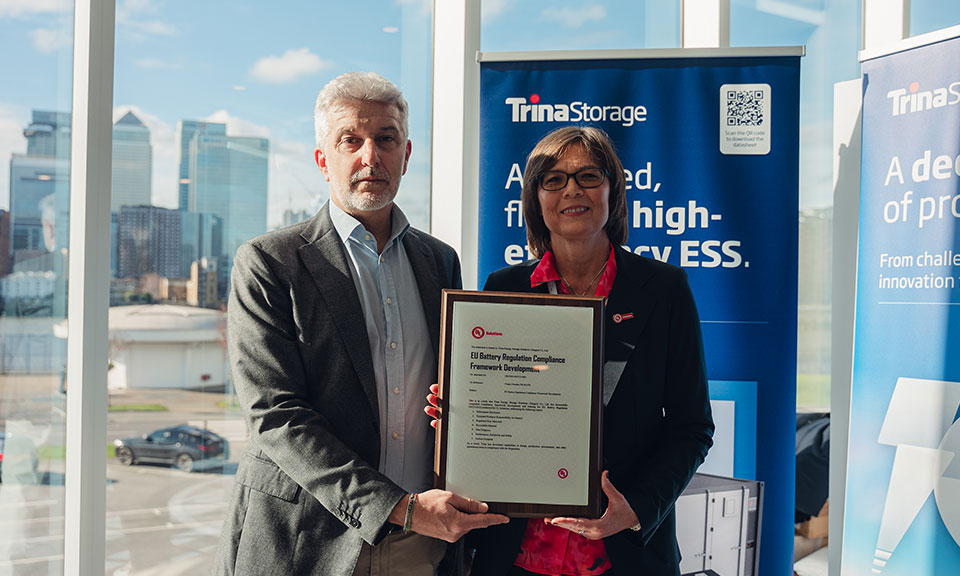
As the EU Battery Regulation reshapes market expectations, Trina Storage chose to respond with a structured and forward-looking compliance framework rather than a reactive adjustment.
When asked to introduce the framework, Gabriele Buccini, Head of Trina Storage Europe, explained that the framework integrates regulatory requirements across the entire battery lifecycle. Given the regulation's complexity, the company began preparing early, embedding compliance directly into product design, system architecture, and internal processes.
To achieve this, Trina Storage worked closely with UL Solutions to design systems, modules, and procedures aligned with the regulation's principles. Rather than treating compliance as a checklist exercise, the company incorporated the regulation's objectives as guiding principles for product development and operational processes. By integrating these principles from the outset, regulatory alignment becomes a natural outcome of how products are designed and delivered.
From UL Solutions' perspective, Katja Parker-Akentieva, Global Director Enterprise Sustainability, Renewables at UL Solutions, highlighted that differentiation lies in timing and comprehensiveness.
The regulation itself covers more than ninety articles and includes requirements such as:
Katja noted that Trina Storage implemented its compliance framework early and in a comprehensive manner, positioning the company strongly for the European market.
She also highlighted the broader industry context. As renewable penetration rises, demand for battery storage is accelerating. Wood Mackenzie forecasts Europe's cumulative storage capacity will grow at around a 23% CAGR over the next decade, creating clear first-mover advantages for companies that align early with evolving regulatory and sustainability standards.
UL Solutions supports the battery energy storage value chain by working with investors, developers and manufacturers to help derisk projects and ensure technologies are safe, sustainable and bankable.
As transparency and traceability requirements intensify under the new regulation, Katja emphasized the importance of robust end-to-end data systems and digital platforms. Companies must be capable of collecting, contextualizing, and analyzing data to enable near real-time visibility across the product lifecycle.
Beyond digital infrastructure, several additional capabilities are critical: accurate battery classification, strong supplier communication, and thorough technical diligence to identify and mitigate risks. Readiness for the digital battery passport is also becoming increasingly important.
Katja further noted that strong R&D and manufacturing capabilities remain fundamental. Transforming raw materials into a superior product is not only a technical process but also a financial consideration. Investors and lenders closely evaluate manufacturing excellence when assessing the bankability of projects, underscoring the close connection between operational quality and financing outcomes.
Gabriele reinforced the importance of third-party acknowledgement in this context. For Trina Storage, having UL-acknowledged compliance fundamentally strengthens customer confidence. The acknowledgement ensures that compliance efforts are independently audited and verified, which accelerates permitting, financing, and broader development processes.
He stressed that this is not a one-time achievement. As the battery regulation continues to evolve in the coming years, Trina Storage intends to pursue additional audits and certifications, continuously aligning with new requirements. Maintaining compliance is an ongoing commitment rather than a static milestone.

Katja described the EU Battery Regulation as the most comprehensive framework the battery industry has seen, signaling that safety and sustainability are no longer box-ticking exercises but a true license to operate.
The regulation introduces requirements including CE marking, carbon footprint declarations and recycled content targets. As these measures are phased in, companies that build strong digital traceability systems—such as high-quality digital battery passports—are likely to gain a competitive advantage.
Looking ahead, Katja expects compliance processes to become increasingly digitalized and automated. Carbon transparency, circular economy practices and manufacturing quality will play a growing role in project bankability. Drawing on UL's advisory work in project financing, she noted the strong link between manufacturing excellence and risk reduction for investors.
Ultimately, she said, batteries will increasingly be judged not only by performance, but by how responsibly they are sourced, manufactured and recycled.
Gabriele then outlined Trina's business development in Europe. He highlighted Trina Storage's rapid expansion in Europe as the company builds its presence in the global storage market.
After entering the storage sector roughly a decade ago, Trina Storage signed its first overseas project in the UK about five years ago. Since then, the company has developed three generations of battery storage cabinets and expanded its system integration capabilities.
The European business has grown significantly, with the regional team expanding from around 25 to more than 80 employees. Projects have been signed across the UK, Germany and roughly a dozen European countries, with a regional pipeline of around 6–7 GWh currently in execution or operation. Globally, Trina Storage has signed approximately 20 GWh of projects for delivery.
Gabriele emphasised that Europe remains a key strategic market for the company. Aligning with the EU Battery Regulation—supported by UL-acknowledged compliance—will help strengthen customer confidence while supporting safer, more sustainable and bankable storage projects.
In an increasingly regulated and capital-sensitive market, compliance is no longer a supporting function — it is a strategic pillar. Regulatory readiness, transparency, and manufacturing excellence are becoming foundational to long-term success in Europe's rapidly expanding battery storage market.
Through early implementation, comprehensive compliance design, and independent acknowledgement, Trina Storage and UL Solutions together demonstrate how regulatory alignment can translate into enhanced safety, sustainability, and bankability.


Customer Service Hotline
400 689 0000


