


Select region / language
CHINA
NA
LAC
Global AI Compute Is Running Out of Power: Why Hybrid Energy Systems Are Emerging as the New Backbone of AI Infrastructure
Across North America, Europe, the Middle East, and Asia-Pacific, hyperscalers and data center developers are investing hundreds of billions of dollars to deploy the next generation of AI infrastructure. Yet despite rapid advances in chips, networking, and liquid cooling technologies, a far more fundamental constraint is now threatening growth:
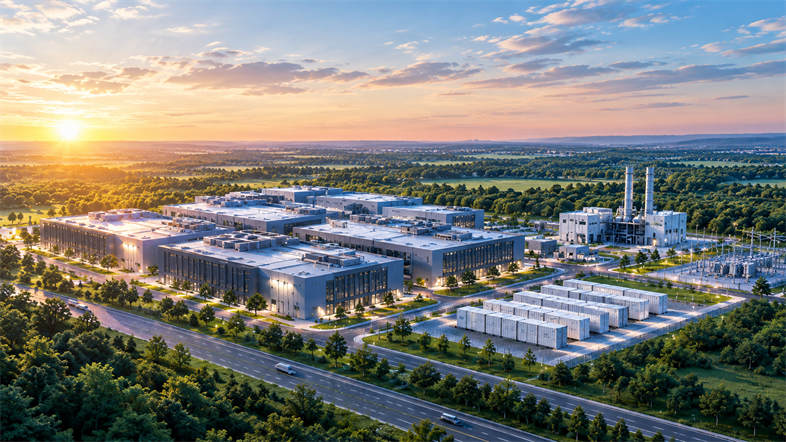
For decades, digital infrastructure planning assumed that electricity would always be available when needed.
That assumption no longer holds.
According to BloombergNEF, global data center power demand has already exceeded 84 GW, with an additional 23 GW currently under construction. The organization expects AI-driven demand to continue accelerating significantly over the next decade.
Meanwhile, S&P Global forecasts U.S. data center electricity consumption to nearly double by 2030, reaching approximately 728 TWh annually.
The question is no longer solely about how much AI compute will be built, but also about how rapidly supporting power infrastructure can be delivered alongside it.
North America: Where the Power Challenge Is Most Visible
Nowhere is this challenge more visible than in North America.
Northern Virginia, Texas, Ohio, Arizona, and other major AI development hubs are experiencing unprecedented pressure on transmission infrastructure.
Grid operators are facing a surge of new load requests that far exceeds historical planning assumptions. PJM alone expects approximately 70 GW of additional demand growth from large-load customers such as data centers over the coming years.
According to the U.S. Department of Energy, expanding transmission infrastructure has become a national priority as data centers emerge as one of the largest drivers of future electricity demand.
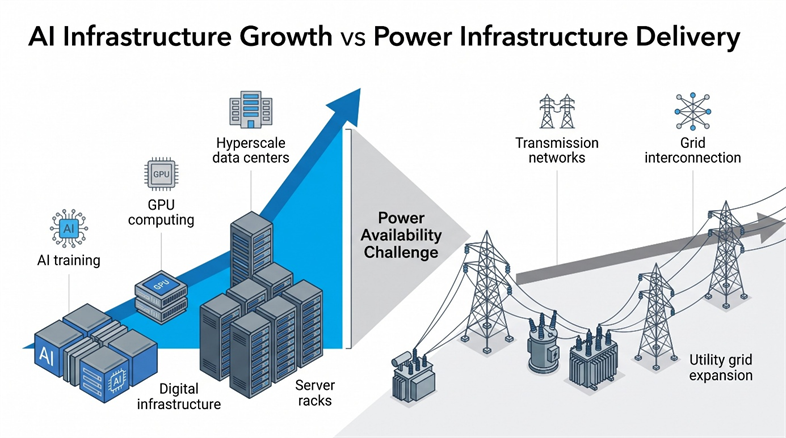
Wood Mackenzie summarizes the challenge succinctly:
The biggest constraint facing AI infrastructure is no longer compute—it is access to reliable electricity.
For hyperscalers racing to deploy GPU clusters, waiting three to five years for grid upgrades is increasingly becoming an unacceptable business risk.
AI Workloads Are Creating a New Category of Power Demand
Beyond sheer electricity consumption, AI data centers introduce an entirely different operational profile.
Unlike conventional enterprise facilities, AI training and inference clusters create highly dynamic load behavior.
Large GPU clusters can move from steady-state operation to peak demand within milliseconds.
These rapid load changes create challenges that traditional power infrastructure was never designed to handle:
Extreme Load Ramping
Power demand can fluctuate dramatically within seconds as computing workloads change.
Power Quality Requirements
AI facilities require stable voltage and frequency conditions to maintain continuous operation and maximize GPU utilization.
Ultra-High Availability Expectations
Downtime is no longer measured in inconvenience—it is measured in millions of dollars of lost compute value.
Future Scalability
Many campuses are planned for expansion from hundreds of megawatts to gigawatt-scale deployments.
This combination of speed, density, and volatility is forcing developers to rethink conventional approaches to power supply.
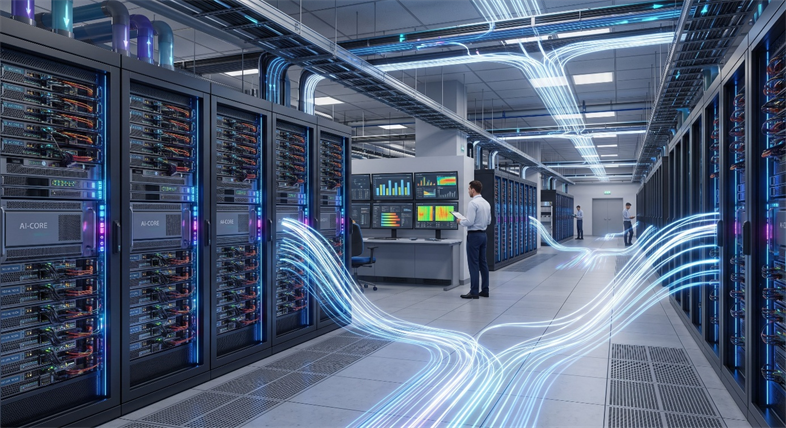
Historically, data centers relied on a relatively straightforward architecture:
Grid Connection + Backup Diesel Generators
For AI-scale facilities, this model is increasingly insufficient.
The grid may not be available when needed.
Conventional backup generators were historically designed to provide emergency resilience during grid outages. While generator technologies can be configured for prime-power applications, traditional data center backup systems were generally not intended to serve as the primary long-term energy source for continuously growing AI campuses.
Renewable-only approaches, while attractive from a sustainability perspective, often struggle to provide the level of dispatchable, around-the-clock power required by hyperscale AI campuses.
According to Wood Mackenzie, the near-instantaneous load changes associated with AI workloads can place significant stress on gas turbines and reciprocating engines, creating operational and reliability concerns.
The industry increasingly recognizes that no single technology can independently solve the AI power challenge.
Why Hybrid Power Architectures Are Gaining Attention
To address these challenges, many developers are evaluating alternatives to the traditional model of waiting for full utility capacity to become available.
Industry discussions increasingly focus on a range of approaches, including on-site generation, co-located power plants, and hybrid systems that combine thermal generation with battery energy storage. While implementation strategies vary by project, the common objective is to bring power online sooner while maintaining operational reliability and future grid integration options.
Within these architectures, gas-fired generation and battery energy storage often play complementary roles.
Gas turbines and gas engines can provide firm, dispatchable power capable of supporting large-scale facilities. Battery energy storage systems (BESS), meanwhile, can respond almost instantaneously to fluctuations in demand, helping stabilize system performance during rapid load changes. Wood Mackenzie notes that the highly dynamic characteristics of AI loads can create challenges for generation assets, leading developers to evaluate battery storage as a fast-response balancing resource.
Rather than viewing generation and storage as competing technologies, many emerging designs treat them as coordinated assets within a broader power architecture:
The result is a more resilient and adaptable energy platform capable of supporting the evolving requirements of AI infrastructure.
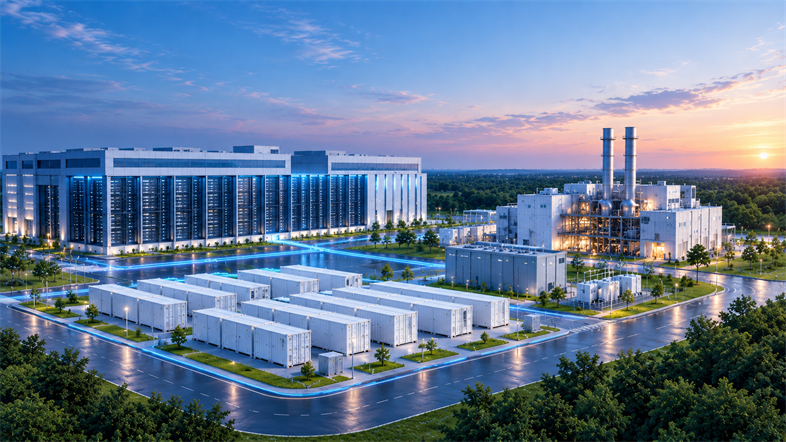
While North America is currently the most visible battleground for AI power infrastructure, similar dynamics are beginning to appear globally.
In Europe, growing data center demand is beginning to place additional pressure on transmission networks and grid connection processes. S&P Global projects European data center electricity demand to nearly double by 2030, with grid access increasingly cited as a key development challenge.
Across Asia-Pacific, data center growth is accelerating alongside broader industrial electrification, creating new planning challenges for power systems. S&P Global estimates regional data center demand could increase from approximately 267 TWh in 2025 to nearly 500 TWh by 2030.
In the Middle East, national AI initiatives and large-scale digital infrastructure investments are driving interest in rapidly deployable power solutions that can support new developments while maintaining long-term scalability.
While regional energy mixes differ, a common theme is emerging: digital infrastructure is expanding faster than many power systems were originally designed to accommodate. As a result, developers, utilities, and energy providers are increasingly exploring a broader set of supply strategies, including hybrid energy architectures that combine firm generation, storage, and advanced control systems.

The conversation around AI infrastructure is often centered on compute performance, networking capacity, and cooling technologies. Increasingly, however, energy infrastructure is becoming an equally important part of the equation.
No single power strategy will fit every project, market, or regulatory environment. Yet the rapid growth of AI is encouraging the industry to evaluate new approaches that can help balance speed, reliability, flexibility, and scalability.
As AI deployments continue to expand globally, hybrid energy architectures are moving from a niche concept to an increasingly important topic in discussions about the future of digital infrastructure.
Meet Us at Data Center World POWER
As AI infrastructure evolves, so must the energy systems that support it.
Join us at Data Center World POWER to explore how integrated hybrid architectures—combining battery energy storage, firm generation, and advanced controls—are helping developers accelerate Time-to-Power while maintaining the reliability and flexibility required for the AI era.
The future of AI starts with power.


Customer Service Hotline
400 689 0000


